Showing posts with label American Goldfinch. Show all posts

Friday, August 8, 2014

Hummingbirds and sunflowers...

We often think of hummingbirds sipping nectar from red, tubular-shaped flowers, but if you've ever spent any time around sunflowers, you know they are a favorite of hummers too...

A juvenile male Ruby-throated Hummingbird sips nectar from a disc floret on a sunflower.
...and there is a reason hummingbirds love sunflowers. If you look closely at the center disc of a sunflower (or a black-eyed susan, zinnia, or any other daisy-like flower), you'll find hundreds of tiny tubular shaped flowers (called florets). These little florets are perfect flowers that each contain drops of nectar.

Hummers have precise eye-bill coordination to be able to hover and drink from such a tiny cup!
A happy hummer!

What is a composite flower?
A composite flower looks like one big flower, but it's really an inflorescence (or grouping) of hundreds of tiny flowers called florets. Daisies, black-eyed susans, purple coneflowers, zinnias, asters, dandelions, etc., are all composite flowers.  There are two types of florets in a composite flower:

Ray florets - are located along the perimeter of the flower head and form what look like petals that "radiate" out from the center (which is why they are called rays). Ray florets contain only a pistil (the female reproductive organ).

Disc florets - form the center disc of the flower head. Disc florets have a stamen and a pistil, so they are considered tiny, perfect flowers. Hundreds of disc florets create the flower head.

("Perfect" flowers contain both reproductive organs--a pistil (the female reproductive organs) and stamens (the male reproductive organs; the anthers contain the pollen). Lilies, daffodils, petunias, etc. are perfect flowers.)

Cross-section of a composite flower
When you realize that a composite flower is made up of hundreds of florets, all of which are tiny tubular flowers filled with nectar, it's easy to see why hummingbirds love sunflowers!

When the florets are finished blooming, and the seeds ripen (in the ovary of the pistil), American Goldfinches and Northern Cardinals take over...

An American Goldfinch eats sunflower seeds in the late evening light.

(I photographed these birds in my friend Sarah's beautiful garden.)

Monday, July 29, 2013

...people love to paint birds!

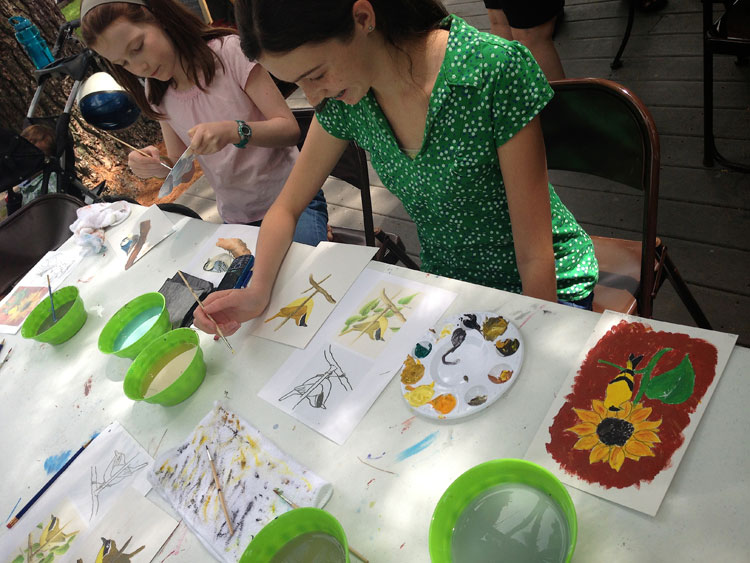
Matty and I had a blast today teaching bird lovers how to draw and paint birds at the Little Miami Scenic River and Trail Center. I had no idea there were so many people who wanted to learn how to paint birds! We were swamped with artists of all ages all afternoon. I really enjoyed watching everyone's interpretations come to life on paper. Here are just a few of the artists and their creations...

...this dad had no idea he could paint. It was his first time to pick up a paintbrush!
I love this painting...a very cool rendering of a female Northern Cardinal. 

...focus and concentration...this little girl knew exactly how to bring her eagle to life.

...using the "two circles and a triangle" method made it easy to draw birds! 

...love these deep, rich colors. This little girl had a sharp eye for design.

...a software developer checked his analytical self at the door and got his art on. He opted for the "circle and triangle" bird drawing method and created his own design of a black-capped chickadee (this was his first time to paint and draw!). 

...and a mechanical engineer created this gorgeous Blue Jay by sketching out her own design too. Circles and triangles go a long way with birds. I love all of the shading and dimension.

These girls really worked hard and created beautiful paintings...while laughing and having fun too!

...diligently mixing paint to get the exact color. This young artist really enjoyed creating custom colors. She totally nailed the olive green that shows on a Hooded Warbler.

...sweet, sweet paintings. I love the way these sisters created their paintings of a White-breasted Nuthatch and a female Northern Cardinal. Beautiful!!!

All of these bird-loving artists took part in the free bird painting workshop Matty and I hosted at the Little Miami Scenic River and Trail Center on Sunday. Click here for yesterday's post to find out what it was all about and to learn more about Little Miami, Inc. (LMI) and the Little Miami Scenic River and Trail Center. I'm going to put another post together soon showing all of the cool stuff in the center and explain more of how LMI protects the Little Miami River...and some of the people behind the organization. More to come...

Thursday, March 22, 2012

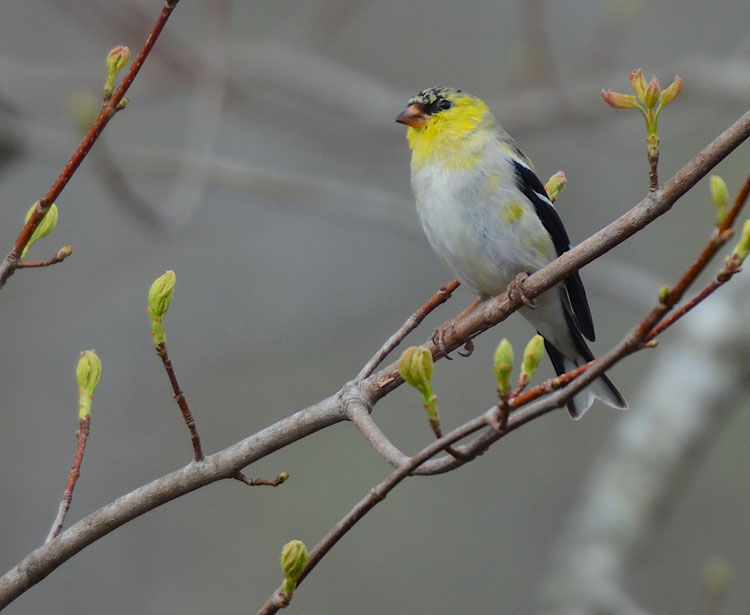
Scruffy Chic...the must-have spring wardrobe choice for happenin' male goldfinches...

Yet another sign of spring--from the changing of the guard to the changing of the wardrobe...

Male American Goldfinches (Spinus tristis) everywhere have started undergoing their spring molts.
Before you know it Scruffy Chic will be out of style and Sleek Yellow will be in!


Wednesday, December 28, 2011

Where is our snow?

I miss it. Last year at this time we had well over a foot of snow on the ground, and when I looked out our living room window, I had cute little birds like this staring back at me...

...an American Goldfinch in the snow.

...he's killing me with the head tilt! That little move ratchets up the cute-o-meter like nothing else...

Male American Goldfinches are always pretty, especially in the summer when their breeding plumage glows gold in the sun, but in the winter, when they return to their basic plumage, they fade to an olive brown with only a hint of their former glory around their eyes and neck. Suddenly, they blend with the browns and greys of dead winter and barely raise a second glance, but when snowflakes fall and they sit with a backdrop of bright white snow, they once again glow gold and demand attention!

"I'm a ball of fluff, and I can melt any heart..."


Yesterday we had three flakes of snow. It was supposed to be an inch, but it fizzled into rain. I have snow gear galore—boots, gloves, down pants and a down coat, and a panda bear hat to top it all off—but unfortunately, no where to wear it! Hurry up and get here snow...

(I took these photos 12-12-10. We had snow, snow, snow then.)

About our rain...
We've had our wettest year on record. It has rained almost every other day this year...about 72 inches of rain, which scored us another record—the wettest city in the nation's top 100 largest cities. My hubby, Rick, filled me in on the stats last week. We normally get 137 days of rain. This year, we've had 187 days. If only all the rain this month had been snow... :-)

P.S. Happy Birthday, Dad!!!

Friday, July 8, 2011

In the summertime when the weather is hot...

An American Goldfinch wraps himself in summer...

...and shares it with anyone who looks his way.

I found this fellow in the field midway along the Bluejacket Trail in Shawnee Lookout Park. Totally different from Shawnee State Park, Shawnee Lookout is located in southwest, Ohio and is a Hamilton County Park. I drove out Wednesday because I'd never been there and wanted to get the lay of the land. It's about an hour from my house, and I know I'll be back! Today (Thursday) I returned to the area and canoed the Great Miami River, looking for and photographing turtles!! More to come on that...

Saturday, December 11, 2010

Goldfinches like crabapples too...or at least the seeds inside them!

While the American Robin (from this earlier post) was plucking berries from the tree and swallowing them whole, a sweet little American Goldfinch was employing an entirely different method to get his lunch. He would pierce the skin with his sharp, pointed beak and work through the pulp until he found a seed. He left the remaining skin and pulp on the tree.

An American Goldfinch perched outside my living room window gives me the eye as I photograph him eating the seeds in the crabapples.

...here he is piercing the skin. He then neatly rooted through the pulp until he found a seed.

Here he's getting ready to go back into the crabapple. If you look at all the berries, you can see those he's neatly picked through and left hanging on the branches.

Wednesday, October 20, 2010

More bird paintings...this time, impressionistic.

These were fun, and I loved doing them. Working late at night, I painted this series without an under sketch. I let the paintbrush do the work, watching the images appear as the paint went down. I'm a night owl, which is a very bad thing to be when you're a birder (unless you study owls), but it's a very good thing to be when you paint. Once the hand on the clock clicks past midnight, the soothing night spirits take over and help you along. All is quiet, no one is around, gentle night sounds slip through the window, and time slows down.

Painting #48, Goldfinch on Sunflower
Acrylic, 9"x12" acrylic paper

Painting #49, Goldfinch on Sunflower 2
Acrylic, 6"x6" canvas paper

Painting #50, Goldfinch on Sunflower 3
Acrylic, 6"x12" canvas paper

Painting #51, Goldfinch Almost on Sunflower
Acrylic, 6"x6" canvas paper

...chugging along. I'm passed the half-way point.

All summer long I worked to reverse the night-owl thing, and I succeeded for a while, but I've slipped back to my old ways. I've been a night owl my entire life. I remember when I was in the first grade my mom had to pull me out of bed, sit me at the kitchen table and give me a cup of java to help me move. (I also remember her advising me I might not want to mention the coffee bit to my teachers. Back then kids didn't drink coffee. I don't know if they do now because Matty's an early bird.) No one in my family is a night owl...they are all early birds. Where on earth did this come from? Now, because of Meniere's Disease (an inner ear disorder), I can't drink coffee. I've been caffeine free for about 6 years, so I don't have that aid to make getting up easier. 6:15 comes very early, and I'm not keen on it, but I get up anyway. (I am tired of living on 4 hours of sleep, though...and I'm going to bed early tonight!)

Wednesday, October 13, 2010

Painting birds in an impressionistic style...

Matty art-directed me with these paintings. He's taking an art class right now and is helping me learn to be a bit more creative and looser in my style. He's all about creating something different and new, so he challenged me to get a little modern. In his exact words, "We all know you can paint and draw a bird, but can you make it interesting?" Okay professor....

Painting #39 Northern Cardinal in Evening Snow

I saw this bird in the dead of winter at a local park. Snowflakes were falling heavily and all was quiet except for the muffled sound of new snow consistently accumulating on old snow--a special sound you have to strain to hear, but one that refreshes and soothes. The bird was hidden deep in the center of an oversized bush, protected by branches as night was beginning to fall. The temps were wickedly frigid and this fellow was fluffed to gargantuan extremes. He was one of the most beautiful cardinals I had ever seen.

I had originally painted this guy in full form sitting on a branch, but Matty said, "Nope...get rid of the branches and show me something interesting." So...I just started painting over the branches and the bird, thickly applying paint where it felt good, remembering the darkness...and the cold...and the silent sound of falling snow. Eventually this fellow emerged, and Matty liked him. He liked the chunkiness of the brown paint and the fact the only things in focus were the bill and eyes. He said it was an interesting painting because you had to think about where the bird was and what he was doing.

Painting #40 Goldfinch in the Grass

A saw this little American Goldfinch in a meadow last year. He was surrounded by green leaves and brown grass. Autumn was just starting to creep in, and he was looking a bit scruffy as he carefully poked through teasel stalks. His molt had just begun and his beautiful breeding plumage was starting to fade into the subdued shades of winter, but as I stood in the field and watched him, thoughts of winter were no where around. It was hot that day...very hot, and it felt like summer would go on forever.

I also had already painted a branch with this one and was about to paint the teasel seed head the bird was looking at when Matty said, "Why do you want to add that in? You don't need it. It's interesting right now to see him in the intense green. There's energy. Leave him alone and get rid of the branch." I stammered, "Really? Don't I need to add details to the bird....don't I need to add shadow?" He added, "Mom, can you tell it's a goldfinch?" I shook my head yes. "Then...leave it." So I did, and I love it! I can feel the heat of the day and the sweetness of the bird. I remember everything without seeing the detail.

Painting #41 Autumn Chickadee

Chickadees are my favorite bird. I can hear their cheerful sounds outside my kitchen window all year long. It never fails, as soon as a Chickadee sound registers in my brain, happiness and joy follow! They are happy little powerhouses, and it seems they have the same effect on lots of people. Thank goodness for Chickadees (especially in grey and frigid February). I saw this fellow last year too. He was about 20 feet off the Little Miami trail washed in a blaze of autumn color. Temps were just starting to drop, and he was working hard to gather food for the winter.

Well...this painting does not carry with it Matty's seal of approval. We love the background and the soft warmth of the autumn color, but unfortunately Matty wasn't in the kitchen when I was painting this one, and I added a bit too much detail to the bird, and what on earth was I thinking when I added the "floating" branch? I could go back and paint over it and make it cool, but I'll let it stand as is and move on to the next painting. I already have painting 42 finished and have 43 and 44 in the works. I've got to keep moving if I want to finish the 100 Paintings in a Year Challenge by December 31, 2010!

Matty taught me a lot about freedom with paint in this series. He has a creative eye. Matty, thanks for helping me grow as an artist!

Tuesday, October 5, 2010

Electronic Bird Art - ElectroBirds!

...when you have fun with the Glowing Edges filter in Photoshop, our favorite feathered friends take on a new, hip, hot, and electrified image! I can dig it, baby...

Chestnut-sided Warbler made hip with glowing edges.

American Goldfinch--Vegas style!

A juvenile American Bald Eagle leaps to his nest. Truly, though, it's electrifying seeing him even without the glowing edges!

A Red-shouldered Hawk is beautiful in neon...

...the same Red-shouldered Hawk on his return flight is just as striking.

Even a Brown Pelican becomes cool when he's powered on...

...but a sweet little Sanderling seems a little out of place in his hipster garb!

Wednesday, September 8, 2010

Broken and tattered, but still beautiful...

Eastern Tiger Swallowtails at Fort Ancient
Yesterday I slipped out of work early and headed up to Fort Ancient. I was hoping to find a small flock of American Goldfinches as they worked the thistle-laced meadows looking for silky thistledown to take back to their nests, and I wasn't disappointed. As I walked toward the meadow next to the museum I could hear them, happy and chatty in their flight, but butterflies were everywhere, and their soft and gentle movements soon stole my attention away. From a distance, the butterflies looked fresh and new, but behind the camera lens I could see their wings were weathered, tattered and torn. (Click here for photos of goldfinches tugging out thistledown last September at Fort Ancient.)

The thin membrane of a butterfly's wings is covered in tiny scales arranged like shingles on a roof. Not built for long life, butterflies lose scales every day as their wings touch leaves, flower petals and other butterflies. Their color fades as the powdery scales drop away.

Even though the darks are a bit faded and chunks have been torn from its wings, this swallowtail's iridescent blue scales are still vibrant and beautiful. Two types of color show in a butterfly's scales--pigments, such as melanin, create black and other deep shades, while a microscopic open lattice structure creates reflective surfaces that form the iridescent blues and greens (similar to the structural color and pigment in hummingbird feathers).

This Eastern Tiger Swallowtail looks like it's been through a scrape or two. I wonder how many birds have nipped at its wings or how many buffeting winds it's dodged. Butterflies can fly with as much as 70% of their wings missing!

...since butterflies have no means of self-repair, they can become ragged within a few weeks and many species die within a month. (There are exceptions, some species overwinter in a dormant state and can live up to a year, and, of course, those amazing migrating Monarchs can live about eight months).

Every day of living shows in a butterfly's wings.

Female Eastern Tiger Swallowtails also come in a dimorphic dark form (shown in the upper right). Dark form females mimic Pipevine Swallowtails. While caterpillars, Pipevine Swallowtails munch on pipevine leaves, which are toxic. The result is a foul-tasting butterfly that birds avoid. (Click here for the Pipevine's story...)

A fresh Tiger Swallowtail (left) shares a thistle plant with two other swallowtails of varying ages. There were easily 30 or 40 Eastern Tiger Swallowtails in this little meadow, all nectaring on the thistle blossoms while goldfinches joined them here and there, plucking thistle down from spent flowers...

...and taking it back to their nests.