Showing posts with label Jewelweed. Show all posts

Monday, August 24, 2015

Spotted Jewelweed sparkles along the Little Miami River...

Bright splatters of orange along the riverbank in August can mean only one thing, Spotted Jewelweed (Impatiens capensis) is in bloom! Matty and I saw these orange gems last weekend along the Little Miami River at Spring Valley Wildlife Area. The temps were warm, the humidity was high, and the cicadas were singing...all indicative of late summer and the slow march to autumn...

Coevolution of jewelweed and hummingbirds is much studied. The shape of the nectar spur is perfect for its principle pollinator, hummingbirds.
A Spotted Jewelweed flower dangles from a translucent green stem. This beautiful flower is a powerhouse of fuel for the Ruby-throated Hummingbird during fall migration. 

A hummingbird's horn of plenty...
Spotted Jewelweed's conical horn-shaped flower with its tubular nectar spur was made for hummingbirds, literally. The flower coevolved with hummingbirds and is the main nectar source for the tiny bird on its return flight south in late summer and early fall (jewelweed blooms well into October). In return, the hummingbird is the flower's main pollinator. The downward angle of the nectar spur forces the hummingbird to go deeper into the flower to reach the nectar, which means more pollen ends up on the hummingbird's head, ensuring pollination and making the hummingbird a very efficient pollinator.  To learn more about nectar spurs and pollinators, click here for the article, "The relationship between nectar spur curvature in jewelweed (Impatiens capensis) and pollen removal by hummingbird pollinators," by Steven Travers, Ethan Temeles, and Irvin Pan.

When you look at the flower, it has a cone shape that resembles a horn. The nectar spur is located at the base,  which is a perfect location for a hummingbird.
When you look at Spotted Jewelweed in profile, you can see how its horn-of-plenty shape and the small tubular spur at the base of the flower that holds nectar is perfect for a hummingbird.

Disperses seeds like a pro...
Jewelweed's common name, Touch-me-not, comes from its unusual method of seed dispersal. When the seed pods ripen, the slightest touch (even that of a strong breeze) triggers a pop that ejects the seeds up to four feet away. Unlike most wildflowers, Jewelweed is an annual, not a perennial, which means its only way to reproduce is through seed. Efficient seed dispersal is critical to its survival, so it's no surprise it has developed such a cool method of ensuring its seeds get distributed. In addition to jewelweed's showy horn-shaped flower, another type of flower called a cleistogamous flower contributes to seed production. This flower is inconspicuous, small and green, and it never opens. It is self pollinated, and when it ripens, the seeds are not thrown as far. Botanists assume this ensures some seeds stick close to the parent plant where they will thrive in the same habitat. The seeds from the pollinated flowers come from genes from two parents and are more likely to be able to survive in conditions that might be slightly different, so they are tossed far and wide. Additionally, it's scientific name of "Inpatiens" derives from this "impatient" explosion of seeds. Source: "The Book of Swamp and Bog; Trees, Shrubs, and Wildflowers of Eastern Freshwater Wetlands," by John Eastman, pgs 91-95. (p.s. This book is part of a series of three. The other two are "Forest and Thicket" and "Field and Roadside." I love them because they go into detail with lots of interesting tid bits!)  
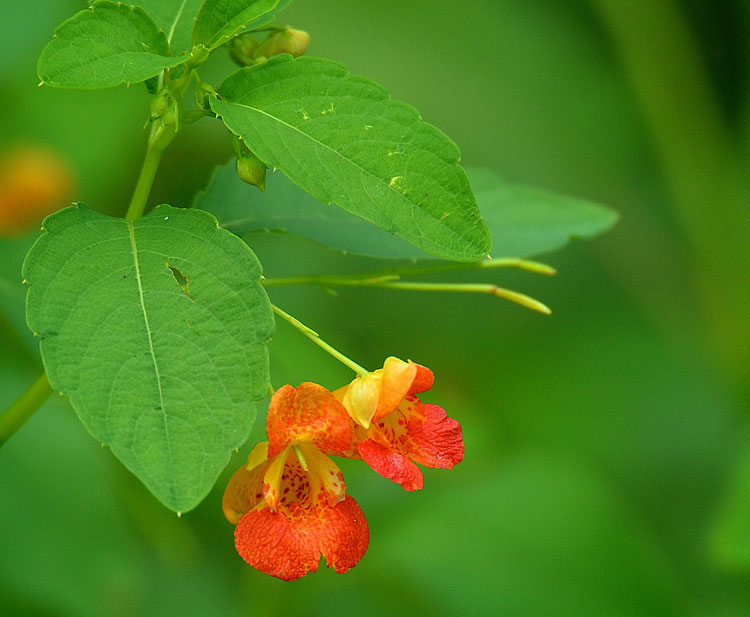
The deep oranges and reds of Spotted Jewelweed are a preview of the warm colors of autumn. It's a perfect transition flower from summer to fall.

The conical shape of a jewelweed flower is perfect for a hat for a fairy or gnome. When whimsy and imagination take over...
...if you want to wax whimsical, this little flower could totally be a hat for a little flower fairy or gnome. Too cute!

Jewelweed needs a lot of moisture to grow well. The dense colonies often form along waterways and muddy and wet ditches.
Jewelweed reseeds itself and grows in large colonies. It forms a dense canopy and can crowd out noxious weeds (much to the delight of migrating hummingbirds in late August, September, and early October).

Sparkling silver leaves...
I used to think jewelweed was named for its jewel-toned orange and yellow colors, but it's not. Several years ago, I photographed the yellow-colored jewelweed (Impatiens pallida), and after researching it, I learned the moniker referred to the leaves. When water droplets form on the leaves, they shine like tiny, sparkling jewels, and when the leaves are placed under water, the underside shines like silver. Click here to see photos of Yellow Jewelweed (Pale Touch-me-not). The post also covers its use as an antidote for stinging nettle burns, poison ivy rashes, and mosquito bites!


Friday, October 7, 2011

Jewelweed (Impatiens pallida), a.k.a. Pale Touch-me-not...

Nodding in the damp edges along the Little Miami River, this beautiful yellow jewelweed flower dangled from its stem like a perfectly crafted pendant...

A beautiful yellow flower with tiny red spots, Jewelweed, loves moist soils found at the water's edge.
Yellow Jewelweed (Impatiens pallida)

I always assumed this flower was named Jewelweed because of the brightly colored yellow and orange jewel tones of the flowers, but it's not. I just read in my "Wildflowers of Ohio Field Guide," by Stan Tekiela, that it's named after the leaves. When water droplets form on the leaves, they shine like tiny, silvery jewels, and according to "Wildflowers of Ohio," by Robert Henn, when the leaves are placed under water, they shine like silver! I tested it out, and it's true.

Touch-me-not is an annual. It disperses its seed through a neat mechanism. When the seed pods dry, with the slightest touch, the pods burst open and spray seeds everywhere!
Pale "Touch-me-not" seems like a strange nickname for such a beautiful, jewel-like flower, but if you touch the seed pods when they're dry, they burst open and spray seeds in every direction. Jewelweed is an annual, so it needs to reseed itself every year, and the old "send the seeds flying method" really gets the job done!

Crushed "Touch-me-not" stems relieves the burn caused by stinging nettle.
If you find yourself in the middle of a stinging nettle patch, look around for jewelweed (the plants often grow near each other because they share the same habitat). Crush the stem of the Jewelweed and spread the liquid on the areas of the skin touched by the stinging nettle leaves. The anti-inflammatory in the Jewelweed helps relieve the sting and burn caused by the leaves. 

I read a lot of accounts where jewelweed could be used the same way on poison ivy and mosquito bites to relieve the itch, but then I read just as many accounts that disproved the notion. I read no accounts, however, that disputed its affect on stinging nettle burns.


This summer while looking for turtles with Paul along the Great Miami River I went off trail a lot and went through several patches of stinging nettle. Ouch...those teeny weeny urticating hairs go through anything, including jeans! The stings burn intensely for about 15 minutes, but then fade, so it's not too bad. The hairs on stinging nettle work like the urticating hairs on stinging caterpillars like the American Dagger Moth Caterpillar (click here for a post) and the Buck Moth Caterpillar (click here for a post). Basically, the hairs are like tiny needles that break off in the skin and dump in several chemicals: acetylcholine, histamine, 5-HT or serotonin, and formic acid (source: Wikipedia). The result is a burning sensation or sting that lasts about 15 minutes. On some, the sting can last much longer, even a day or so!