

Painting 115 - The Hooded Warblers of Shawnee with Maple Leaves
Watercolor, 7x10 Arches Cold Pressed 140 lb Paper
I created this painting from a memory. I lost the photo card that held all the photos from our morning of birding (so sad--I still don't like to think about that), so I had no reference photos of a Hooded Warbler to work from. I kept trying to figure out how I could recreate the wet, dark feel of the woods and the electric yellow of the warbler when a stylized image of the bird surrounded by maple leaves popped in my head. The more I thought about it, the more I liked it, and...to totally mix things up, I thought I'd try using latex masking fluid to protect the leaves so I could really create a lush, dark background. All these years, I've never used latex masking fluid. I didn't even know what it was until a year or so ago...then it sort of scared me. It seemed weird to paint something on the paper and then pull it off, and I worried it would compromise the integrity of the paper's tooth, etc., so I always avoided it. (Craziness...I know.) So I went to the art store and bought a bottle of Windsor and Newton's "Art Masking Fluid" and a bottle of Grumbacher's "Miskit" (Liquid Frisket) and some cheap brushes so I could experiment. I had already drawn a bird and leaves on a 12x16 sheet of watercolor paper, but I thought I'd practice on something smaller, so I created this painting on a 7x10 sheet.
How to use Latex Art Masking Fluid and Miskit (Liquid Friskit)
It's so easy to use masking fluid that I can't believe I was ever afraid of it! So in case there are any other Frisket-timid painters out there, here's what I learned:
Step 1. Paint the masking fluid on the areas you want protected.
Start with a completely dry sheet of watercolor paper, and use an old or cheap paintbrush to apply the liquid. I had bought a pack of cheap paintbrushes just for the task, so I was okay there.

...since I was experimenting, I used both masking fluids at the same time to test which one was better. The orange masking fluid on the bird and the bottom leaves is Grumbacher's "Miskit" and the pale yellow masking fluid on the upper leaves is Windsor and Newton's "Art Masking Fluid."
Step 2. Immediately wash the the masking fluid off the brush with soap and water.
I'm glad I used an inexpensive brush because even though I was careful, a little of the masking fluid remained gummed up in the bristles. I read that you can dip the brush into soapy water before applying the masking fluid to the brush to protect the bristles, but it's so easy to use a cheapy brush...and it's guaranteed!
Step 3. Make sure the masking fluid is completely dry, and then...paint...paint...paint!
I have to admit it was easy painting this background because I didn't have to be careful when working around all the leaves...it was fast and fun!

...for the first wash I laid in Neutral Tint and Burnt Sienna...and let it dry.

...the next wash was Sap Green and Ultramarine Blue.
Step 4. Remove the latex masking.
Rub a kneaded eraser over the masking to pull it away from the paper. You can remove all of it with an eraser, or you can gently pull on it once you get it started and peel it off. I had luck peeling some of it off, but most I had to remove with an eraser, probably because I left the masking fluid on a little long. I had to run out and didn't get back to the painting for about 10 hours. It was easy enough to remove, but I bet it could have been easier if I hadn't waited so long. The instructions say you have up to 24-48 hours, but next time, I'm going to remove it as soon as the watercolor dries. Also...the instructions say to keep the paper with the latex masking on it away from extreme heat and cold (don't let it sit in the sun).
...if you're curious...both the Art Masking Fluid and the Miskit performed exactly the same. They both were easy to apply, and one did not come up easier than the other. It might have been a little easier to see the Miskit because it was orange, but other than that, they were interchangeable. (...and the paper was not compromised at all. It held up to the water and pigment just fine...)
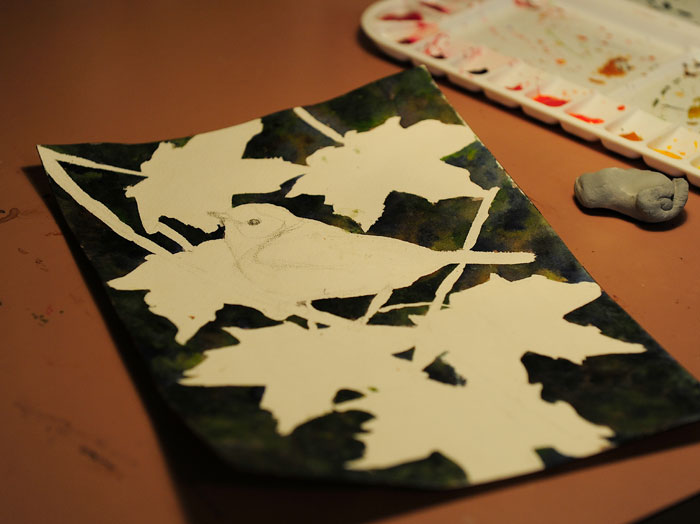
...the painting with the latex masking removed. It really works...and is soooo simple to use!
After I painted the rest of the painting I went back and lifted some of the pigment from the background. It just seemed too dark and drew away from the bird. I simply applied water and blotted with a tissue. This painting is part of the 100 Painting Challenge. If you want to make art a regular part of your life...join up!
P.S. SPRING is in my yard!! The Red-winged Blackbirds flew in on a warm breeze last night. Thank goodness! (In 2009 they arrived a week earlier...post is here.)





 Posts


