Showing posts with label Voice of America (VOA) Park. Show all posts

Thursday, April 11, 2013

Lesser Yellowlegs foraging in a flooded field...

The sky was gray as the late afternoon sun faded away behind heavy clouds, but not even the approaching gloom could dim the spectacular yellow color of the legs on a Lesser Yellowlegs as he picked through the shallow waters of a flooded field at Voice of America (VOA) MetroPark...

Lesser Yellowlegs (Tringa flavipes)
A Lesser Yellowlegs (Tringa flavipes) forages in the shallow waters of a flooded field at VOA MetroPark in West Chester, Ohio.

Lesser Yellowlegs (Tringa flavipes)
A Lesser Yellowlegs has his eye on something...
Is that a Lesser Yellowlegs or Greater Yellowlegs? I'm pretty sure this guy is a Lesser. He didn't seem tall enough to be a Greater. The best way to tell Lesser and Greater Yellowlegs apart is to look at their height, bulk, and the length of their bill. Lessers are about 10 inches tall and have dark bills about the same size as their heads. Greaters are about 14 or 15 inches tall and have slightly upturned bills a little longer their heads. Greaters are more bulky as well.  

Lesser Yellowlegs (Tringa flavipes)
The water in the flooded fields wasn't that deep, but it was perfect for Lesser Yellowlegs. Earlier I saw this fellow nab a small crawdad (aka crawfish or crayfish) and there were empty crawdad shells scattered all over the fields where the water had receded. Maybe he has his eye on another?
Where did all of those crawfish shells come from? To grow larger, a crawfish must shed its shell and grow a new one. It may do this ten to fifteen times in its lifetime. After it molts, it is very soft, so it pumps itself up with water to gain girth and make lots of room for the new shell to form. Crawfish are mature at two years and can live up to seven years (click here for more information on crawfish).

Lesser Yellowlegs (Tringa flavipes)
The classic profile of this beautiful bird...

Lesser Yellowlegs (Tringa flavipes)
 A Lesser Yellowlegs foraging in a vernal pool in late afternoon light.


A Lesser Yellowlegs gets ready to nab dinner while "fishing" in a vernal pool at VOA MetroPark.
...watch out crawdad!

Thursday, January 19, 2012

A Song Sparrow in the late afternoon light...

Sunday I finally started to feel better after recovering from a cold that had kept me indoors for far too long, so I bundled up and headed over to Voice of American (VOA) Park. It was very cold, but it was also blue-sky sunny, and I wanted to see if the American Kestrel that's usually there was hanging around (he wasn't). After checking the frozen lake for winter visitors (there were none save a lone Canada Goose slipping and sliding on the ice), I went off-trail and climbed over the brushy hills that lead to the meadow. It was nearly 5:00 p.m., and the late afternoon sun was doing its winter magic by coloring the dead and bleached brush with warm tones of gold and rust. Suddenly, what seemed like a deserted patch of earth came to life as five small brown birds skittered around, weaving here and there through leaves and bent grass until eventually bursting up in a panic to the safety of stubby snags and the remains of giant pokeweed bushes where they paused to keep a wary eye on me...

A beautiful little Song Sparrow peeked at me from behind a branch, watching warily with just just one eye. If you think he looks cute here, you should have seen him through the camera lens. It would have melted your heart.

...he then moved behind a branch, peeking out with the other eye, obscured from view in shadow...

I'm surprised he didn't lift his little foot and point two little toes at his eyes and then one back at me in that "I'm watching you..." gesture.

The warm browns of a Song Sparrow in late afternoon sunshine...

Eventually the Song Sparrow decided I was no threat...

...turned his back on me, and rejoined his little winter foraging flock on the ground.

When I read this journal entry from Thoreau (April 2, 1853), I had to smile...sounds just like our little sparrows:
"The song-sparrows, the three-spotted, away by the meadow-sides, are very shy and cunning: instead of flying, will frequently trot along the ground under the bushes, or dodge through a wall like a swallow; and I have observed that they generally bring some object, as a rail or branch, between themselves and the face of the walker,—often with outstretched necks will peep at him for five or ten minutes." (Source: page 302, "Early Spring in Massachusetts: from the journals of Henry David Thoreau," edited by Blake, 1881/1893. Click here for the online version of this book.)

Sunday, January 8, 2012

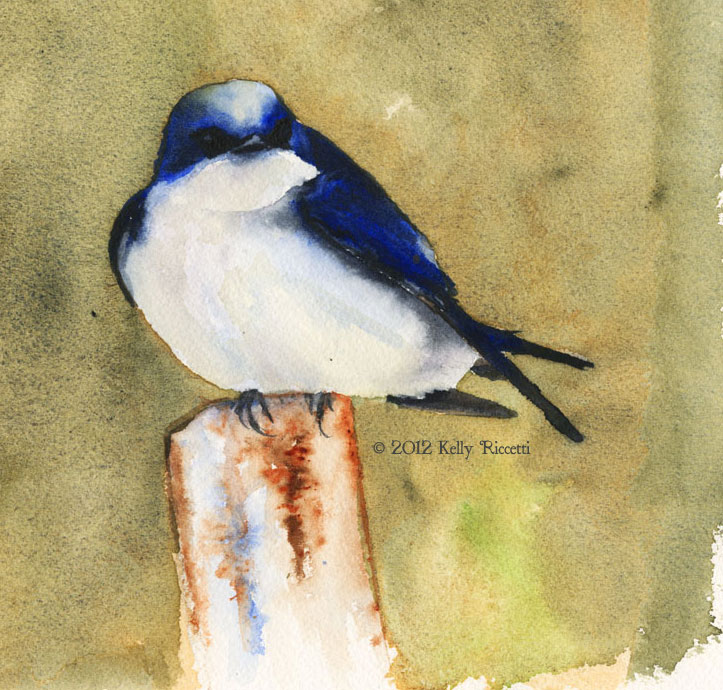
Tree Swallows in the early spring...

Friday it was 62 degrees F in Cincy...and sunny! It's often below zero this time of the year, and thick grey clouds so low in the sky you can almost reach up and touch them can lock us in for months on end, so sunny and blue and warm is a gift I'm glad Mama Nature is handing out. The daffodils have pushed through the earth in our front yard, and it feels like spring, which made me think of one of our earliest spring migrants, the Tree Swallows (Tachycineta bicolor). Every March I anticipate their return, watching and waiting for them to swoop down and into the nest boxes at VOA Park and Pine Hills Lakes. With the spring-like weather and blue, sunny skies, I couldn't help but have these sweet birds on my mind, so I went through old photos for inspiration for this painting...

Painting 204. Tree Swallow in Early Spring on Rusted Steel Post
(watercolor)

...another painting for Laure Ferlita's 100 Paintings Challenge. If you're an artist looking for a challenge, join up!

Thursday, December 15, 2011

"Bob-o'-link, bob-o'-link, Spink, spank, spink..."

Do you remember that line from the poem "Robert of Lincoln," by William Cullen Bryant? I learned it when I was in the fourth grade, and it always stuck with me. When I saw these shots of the Bobolinks from the "rejected June" photos, that line kept running through my head...

"...Bob-o'-link, bob-o'-link,
Spink, spank, spink..."

A male Bobolink in the High Meadow at Voice of America (VOA) Park

Since I was going back to my childhood with this post, I pulled out my first field guide—"Teach-Me about Birds, Flash Cards in full color" to see how they described the Bobolink's unique and beautiful song. Their description is spot on: "A bubbling series of musical notes given in flight or from a perch." It's simple and perfect...."a bubbling series of musical notes..."

A female Bobolink is pretty. Just like a cardinal, she has that "understated elegance."

I like this photo because it clearly shows his pointy tail feathers!

...you can see those pointy tail feathers just a bit here, but this shot really emphasizes his strong feet and legs. For his size, they really are beefy!

"When you can pipe that merry old strain,
Robert of Lincoln, come back again."

I wanted to find the poem, so I looked it up and found a free eBook that has it. Click here for the online version of the book "Poems That Every Child Should Know—A Selection of the Best Poems of all Time for Young People," edited by Mary E. Burt (1906)

Robert of Lincoln
by William Cullen Bryant (1794-1878)

Merrily swinging on brier and weed,
Near to the nest of his little dame,
Over the mountain-side or mead,
Robert of Lincoln is telling his name:
Bob-o'-link, bob-o'-link,
Spink, spank, spink;
Snug and safe is that nest of ours,
Hidden among the summer flowers,
Chee, chee, chee.

Robert of Lincoln is gayly drest,
Wearing a bright black wedding-coat;
White are his shoulders and white his crest
Hear him call in his merry note:
Bob-o'-link, bob-o'-link,
Spink, spank, spink;
Look, what a nice coat is mine.
Sure there was never a bird so fine.
Chee, chee, chee.

Robert of Lincoln's Quaker wife,
Pretty and quiet, with plain brown wings,
Passing at home a patient life,
Broods in the grass while her husband sings,
Bob-o'-link, bob-o'-link,
Spink, spank, spink;
Brood, kind creature; you need not fear
Thieves and robbers while I am here.
Chee, chee, chee.

Modest and shy as a nun is she;
One weak chirp is her only note.
Braggart and prince of braggarts is he,
Pouring boasts from his little throat:
Bob-o'-link, bob-o'-link,
Spink, spank, spink;
Never was I afraid of man;
Catch me, cowardly knaves, if you can!
Chee, chee, chee.

Six white eggs on a bed of hay,
Flecked with purple, a pretty sight!
There as the mother sits all day,
Robert is singing with all his might:
Bob-o'-link, bob-o'-link,
Spink, spank, spink;
Nice good wife, that never goes out,
Keeping house while I frolic about.
Chee, chee, chee.

Soon as the little ones chip the shell,
Six wide mouths are open for food;
Robert of Lincoln bestirs him well,
Gathering seeds for the hungry brood.
Bob-o'-link, bob-o'-link,
Spink, spank, spink;
This new life is likely to be
Hard for a gay young fellow like me.
Chee, chee, chee.

Robert of Lincoln at length is made
Sober with work, and silent with care;
Off is his holiday garment laid,
Half forgotten that merry air:
Bob-o'-link, bob-o'-link,
Nobody knows but my mate and I
Where our nest and out nestlings lie.
Chee, chee, chee.

Summer wanes; the children are grown;
Fun and frolic no more he knows;
Robert of Lincoln's a humdrum crone;
Off he flies, and we sing as he goes:
Bob-o'-link, bob-o'-link,
Spink, spank, spink;
When you can pipe that merry old strain,
Robert of Lincoln, come back again.
Chee, chee, chee.

Sunday, December 11, 2011

Black-eyed Susans, Deptford Pinks, and Ox-eye Daisies in a summer meadow...

This winter when all the color has been drained from the Cincinnati landscapes and only cold greys, bleached beiges, and spotty browns can be seen, I'll come back to this post to remember what a the warm yellows, bright greens, and hot pinks of a summer meadow look like...

Black-eyed Susans ( Rudbeckia hirta) and Deptford Pinks (Dianthus armeria) danced among tall grasses in a warm summer breeze in the High Meadow at Voice of America (VOA) Park.

Black-eyed Susans ( Rudbeckia hirta) in June. VOA Park is one of the few remaining prairie settings in our area. It is fast succumbing to succession because the park officials have not mowed or burned the High Meadow in years. Let's hope they do something this winter so the Boblinks, Eastern Meadowlarks, Savannah Sparrows, and Henslow's Sparrows have a habitat to return to, and so we can sit in the middle of a summer meadow and watch the wildflowers and grasses sway in the heat and breezes of a summer afternoon...

...another grouping of Black-eyed Susans ( Rudbeckia hirta) scattered throughout the fields, their characteristic summer yellow drawing the eye in. American Goldfinches flew overhead in up and down arcs, chattering the day's news while waiting for some of their favorite seeds to ripen...


Black-eyed Susans (Rudbeckia hirta) are native flowers. Originally they could be found only on the prairies, but now can be found scattered in any field.

Deptford Pink (Dianthus armeria) is not a native wildflower. It was introduced from England but has naturalized throughout Ohio. The flower petals have shaggy edges and are covered in white spots.

The Ox-eye Daisy (Chrysanthemum leucanthemum) is also a European import. I remember I was surprised when I read that years ago. I always had thought it a native because it's such a part of summer...


...a video of a field of Black-eyed Susans, Deptford Pink Dianthus, and Ox-eye Daisies swaying in a warm summer breeze in June. Not a lot of action, but the day was so perfect I videoed the scene so I could come back to it in winter for a reminder of what's waiting on the other side of the grey and cold days...

For more of that summery meadow feeling:
Click here for a post on a Savannah Sparrow from the same day.
Click here for a post on Red-winged Blackbirds from the same day.
Click here for a post on Eastern Meadowlarks from the same day.

Wednesday, December 7, 2011

An Eastern Meadowlark in a summer meadow...

I found an online version of "The Complete Prose Works of Walt Whitman" today and read a few passages out of "Specimen Days" (click here for a link to the online version of this book). If you jump to page 196, you'll find the following entry for March 16, "A Meadow Lark:"
March 16.—Fine, clear, dazzling morning, the sun an hour high, the air just tart enough. What a stamp in advance my whole day receives from the song of that meadow lark perch’d on a fence-stake twenty rods distant! Two or three liquid-simple notes, repeated at intervals, full of careless happiness and hope. With its peculiar shimmering slow progress and rapid-noiseless action of the wings, it flies on a way, lights on another stake, and so on to another, shimmering and singing many minutes.
It was such a beautiful entry and reminded me of an encounter with an Eastern Meadowlark I had this summer at Voice of America (VOA) Park. I went back to look at the photos I took, and decided this time around they were good enough to post. Back in June, when the living was easy, and the birds were lit by warm sunlight, I was a lot pickier. These photos didn't make the cut back then, but now......after weeks of gray clouds and rain, those happy, summery, blurry yellow chest feathers look just fine to me...

...an Eastern Meadowlark sings sweetly at VOA Park in West Chester, Ohio.

It was beautiful day when this Eastern Meadowlark sang out his song. I remember wanting to lock the feelings in...it was warm, sunny, and breezy, and lots of Bobolinks, Red-winged Blackbirds and Meadowlarks sang from every corner of the meadow. All the birds were busy sitting on nests or feeding babies, and insects buzzed nonstop. A breeze whipped the June energy through the grasses...and the daisies, Black-eyed Suzans, and hot pink Dianthus nodded approval with each gust. Summer was at full tilt, and it was a perfect day.

Eastern Meadowlarks are short-distance migrants and can be found year-round at VOA, but the birds you see perched amid falling snowflakes in the winter may not be the same birds braving the heat in the summer. Many of our wintering meadowlarks will migrate further north for the breeding season and will be replaced by more southern birds completing their short-distance migration, so this bird and the birds that are at the park now, are probably not the same.

Wednesday, August 31, 2011

A Female Widow Skimmer dragonfly in the high meadow...

Sunday, Rick and I decided to check out the high meadow at Voice of America (VOA) park. I wanted to see if the Bobolinks were still around (I didn't see any...) and if I could photograph a few dragonflies. We also chose VOA because it's a grass field, and grass offers a lot more cushion and therefore less impact on an ankle than cement paths or uneven terrains. I have a reconstructed ankle from an injury back in 1985, and I've developed arthritis in that foot. Every now and then, I do something stupid (like running through a very large parking lot) and severely inflame it. Yeah! Then I have to be careful for a couple of weeks...so grass it was!

Dragonflies were everywhere in the meadow, especially Widow Skimmers, and I was glad when this female flew into camera range and posed right away, resting on a dead stalk. She stayed around for several minutes, flying away for a second or so and then coming right back. Sometimes when she left she nabbed an insect to eat, but mostly she was simply disturbed by the sound of the shutter clicking...

Female Widow Skimmer (Libellula luctuosa) Dragonfly

Female and juvenile male Widow Skimmer dragonflies have dark brown patches at the base of their wings close to their bodies. Adult males do too, but they also have powdery white patches on their wings. Unfortunately a male didn't fly into view, so I don't had a photo of one (click here for a photo on "BugGuide").

Someone once told me Widow Skimmers were named after the wide dark brown/black patches on their wings. These patches were the color of mourning clothes and therefore were called "widow patches." Maybe that's true. I did find a similar reference on the "Living with Insects Blog," here, but I also read that "widow" refers to the fact that male Widow Skimmers leave the females after they lay their eggs (leaving them widows), while males of most other dragonfly species stay with the females (source: Loudon Wildlife Conservancy). That makes sense too, until I read in my dragonfly field guide, "Dragonflies and Damselflies of Northeast Ohio," by Rosche, Semroc, and Gilbert (pg 153), that "males perform territorial battles and hover guard their ovipositing mates tenaciously," which is completely the opposite. So I don't know what to think. Maybe the name "widow" is derived from the Latin "luctuosa," which means "sorrowful" (Latin source: Living With Insects Blog). Whichever the case, thinking of the dark brown patches at the base of the wings as "widow patches" always made it easy for me to remember the name of this dragonfly a long time ago...so I'll stick with that!

Female Widow Skimmers have a yellow stripe running dorsally on their thorax. At the abdomen it splits into two stripes that extend the length of the abdomen. Juvenile males have the same marking.


You can tell this Widow Skimmer is a female and not a juvenile male because of her smooth abdomen. A reference on "The Butterfly Digest" blog, here, explains how to tell the difference between a female and a juvenile male Widow Skimmer dragonfly (with links to BugGuide of photos of the hamule).

...glad you dropped by Widow Skimmer. it was fun photographing you!

Saturday, June 25, 2011

A Savannah Sparrow chips in the High Meadow...

I was so happy when this little Savannah Sparrow flew up in front of me and perched within camera range. The wind was tossing him around, and it was fun to watch him hang on to the leaves. Although succession seems to be stealing a lot of the grassland away at VOA, enough of the High Meadow remains to keep the Savannah Sparrows around. I love their beautiful little faces and the yellow splashes behind their eyes...

...a Savannah Sparrow hunkers down against the wind and holds on tight! He's too sweet for words...

...the Savannah Sparrow gets his name from Savannah, Georgia--one of my favorite cities. No wonder I love this little bird. Alexander Wilson named this beautiful bird after Savannah because that's where he first found one in 1811 (click here for more info).

...the Savannah Sparrow is a newcomer to my town. According to "The Birds of Ohio," by Peterjohn, the first nesting pairs arrived in Cincinnati and Dayton in 1952. Previously they were only migrants in our area.

...in southwestern Ohio, Savannahs are locally distributed and not that common, but you can always find them at VOA Park (at least for the time being). Unfortunately, the park has stopped mowing the High Meadow due to lack of funding, and succession is rapidly changing the grassland environment, which is really sad because the VOA High Meadow is one of the few areas in our populated suburbs where grassland birds (including Henslow's Sparrows) can live.


...psssst...little Savannah...look under the leaf...lunch is waiting!

Savannah Sparrow in the High Meadow from Kelly Riccetti on Vimeo.

...this little Savannah Sparrow is tossed around in the breeze in the High Meadow at VOA Park in West Chester, Ohio. You can hear him chipping if you listen carefully. The louder call is of the American Robin in the tree behind me. (Probably saying something like, "look behind you...I'm here...forget about that little Savannah...Robins rule...I have an orange belly...and I'm bigger...look at me!).

Thursday, June 23, 2011

A Red-winged Blackbird singing in the High Meadow at VOA Park...

Tuesday morning I headed over to Voice of America Park to scout out the Bobolinks, Meadowlarks, and Savannah Sparrows. I was lucky on all accounts, but the first bird I photographed was a Red-winged Blackbird. He was singing and scolding from a tree he was vigorously defending...

A Red-winged Blackbird sings from a tree in the High Meadow at VOA Park in West Chester, Ohio. He sang and scolded nonstop...or at least until I walked past his territory.


Red-winged Blackbird singing in the High Meadow at VOA Park from Kelly Riccetti on Vimeo.

Sunday, February 6, 2011

Study of a Sedge Wren in the High Meadow

Painting 110 - Sedge Wren in the High Meadow
Watercolor, 12x16 Arches Cold Pressed 140 lb Paper

You can't help but be held captive when watching this little bird. He sings and dives and then flies for a short burst...then dives again, then sings again just to let you know he's there, all the while making sure he stays well hidden among the tall grasses and stalks of meadow flowers! The first time I saw this fellow I definitely was riding a birding high. My adrenalin shot up so fast (I'm sure you know that birdie feeling!), and I was so excited. We are on the eastern-most range of this bird, which means we don't get to see him very often. If you look on our Cincinnati Bird List he's a "EEEE," which of course means he's hard to find; and "may not be present at all at this time in some years, but has occurred often enough to form a pattern." I was lucky enough to find him twice. Once on August 2, 2009 (post is here) and again on August 7, 2009. I got a few photos from both visits, but they were not great, so I decided to bring him to life with watercolor. During this summer and early fall I watched and listened for him every time I was in the High Meadow at VOA Park, but he never returned, which is predictable because that's his nomadic little modus operandi...

p.s. While painting this little guy I warmed the colors in his plumage up just a bit because he holds a warm spot in my heart (and that's how I see him in my mind's eye). He's a little more faded in reality (you can see that in the photos I posted here).

Friday, December 31, 2010

Painting 100! American Tree Sparrow with Cubes :-D

Painting #100, American Tree Sparrow with Cubes
Acrylic, 18x24 canvas
Yeah!!

The canvas was big...and the lighting poor, so the photo doesn't capture the painting very well. I need to learn how to photograph large canvases because after working on this one, I know I'm going to want to keep getting larger with my art! To help see the bird, I cropped the photo for detail..

Same painting...just cropped for detail.

I love American Tree Sparrows. They are the sweetest little sparrows, always polite and cheerful, and their song...I LOVE hearing it across the snow. It's so pretty...like tiny little bells when the flock moves together. When I was trying to decide what to paint for the final painting in the challenge, it wasn't hard. I was looking through photos from the end of November and saw a photo of an American Tree Sparrow I saw at VOA Park. A twig was right in front of his face, so it never made it on the blog...but...I could paint the little fellow so we could see all of his face. I wanted to capture that sweetness that always seems to surround these little birds. Hopefully you can feel that when you look at him in the painting.

The photo of the American Tree Sparrow that was the inspiration for the painting. I saw this little guy on Nov 21, 2010 at VOA Park. Our little backyard flock still hasn't arrived at our feeders. I keep waiting. Sometimes they don't show until the middle of January, though. They seem to ride in on really cold arctic blasts...

For my favorite photos of an American Tree Sparrow in our backyard, click here.
For one of my earliest posts and info on American Tree Sparrows, click here.

Happy New Year!!!
I also wanted to thank everyone who visits my blog. I always love reading the comments you leave, and I appreciate the friendships that have followed. It's so wonderful to be part of an international birding and art community!! I hope everyone has a peaceful New Year full of love and birding and art adventures!

I also want to thank Laure Ferlita of Painted Thoughts Blog for hosting the 100 Paintings in a Year Challenge. It has been a wonderful experience! Thanks, Laure!!!