Showing posts with label Little Blue Heron. Show all posts

Thursday, October 25, 2012

Immature Little Blue Herons, photos, sketches, and a watercolor

Once a month, I'm a contributor on the Birding is Fun blog. I often forget to publish those posts on Red and the Peanut, so I'm going to try to add them in every now and then. Here's a post from way back in July:

Little Little Blues are white...
Early this June, Matty, Rick and I went to Hilton Head, SC for our vacation. I visited the nearby Pinckney Island NWP every day to watch the birds nesting at the Ibis Pond rookery. The Little Blue Herons were especially active this year, and the deep slate-colored adults could be seen sitting on nests, preening while they perched at the end of branches, flying overhead with long twigs destined for other nests, or just fluffing up to transform themselves into ridiculously attractive birds, but it was their snowy white offspring that I really paid attention to. The white-feathered young Little Blue Herons were busy flapping their wings, hopping from branch to branch, and waiting and begging for food...

Two young Little Blue Herons stretch and flap their wings. If you look at the tip of the wing feathers, you can see the identifying blue-tipped feathers.
Two young Little Blue Herons stretch and flap their wings from branches near their nest. They were not yet airborne, still gaining strength for their first flights. Here they were watching an adult that had just landed a few branches over, no doubt hoping for food!
Notice the identifying field marks of young Little Blue Herons: greenish legs and feet, and dark-tipped wing feathers
Little Blue Herons have white plumage while they are young and retain the white color for their first year. They often nest with Snowy Egrets, but it's not too hard to tell the two white birds apart. Look at their legs, Little Blue Heron babies have greenish legs and feet. They also have dark blue-gray tipped wing feathers. It's often hard to see the dark-tipped feathers when the birds are at rest, but when they stretch, it's easy to spot the dark tips on the wing feathers.
With the wings folder, it's hard to see the dark-tipped wing feathers that identify this bird as an immature Little Blue Heron, but they are there.
...with the wings folded it's a little harder to see the dark-tipped wing feathers on a young Little Blue Heron, but if you look closely at the farthest end of the wing, you can see the dark tips among all the white.
The nice thing about a rookery, is the birds stay put for you! All this posing and sticking near the nest makes it easy to sketch and draw them. At Ibis Pond on Pinckney Island I love to sit down, set up the scope, and get out the sketchbook. Here are a few quick sketches of the two babies...

...from my sketchbook, pencil sketches of young Little Blue Herons.
...pencil sketches of immature Little Blue Herons
...quick field sketches of immature Little Blue Herons still clinging to the nest site.


...a very quick watercolor painting/sketch of an immature Little Blue Heron
Immature Little Blue Heron (watercolor heightened with black and white conte crayon).
...painted this from a sketchbook drawing earlier this summer.

...and adult Little Blue Heron in full blue plumage is puffed up to a full display of feathers and color.
...and here's papa fluffing up in all his blue grandeur!
(I took this photo last year at Pinckney, but it's one of my favorite fluffing-up shots.)


II have lots and lots of Hilton Head birds sitting in the archives patiently waiting to get out. I need to hunker down, focus and bring those photos to life! (...I still have lots of cool birds, insects, turtles and snakes to write about from Magee Marsh in Toledo, Shawnee State Park in Ohio, and Greenbo Lake in Kentucky too...I'll never get caught up!)

Monday, March 12, 2012

Little Blue Herons always put on a big show...

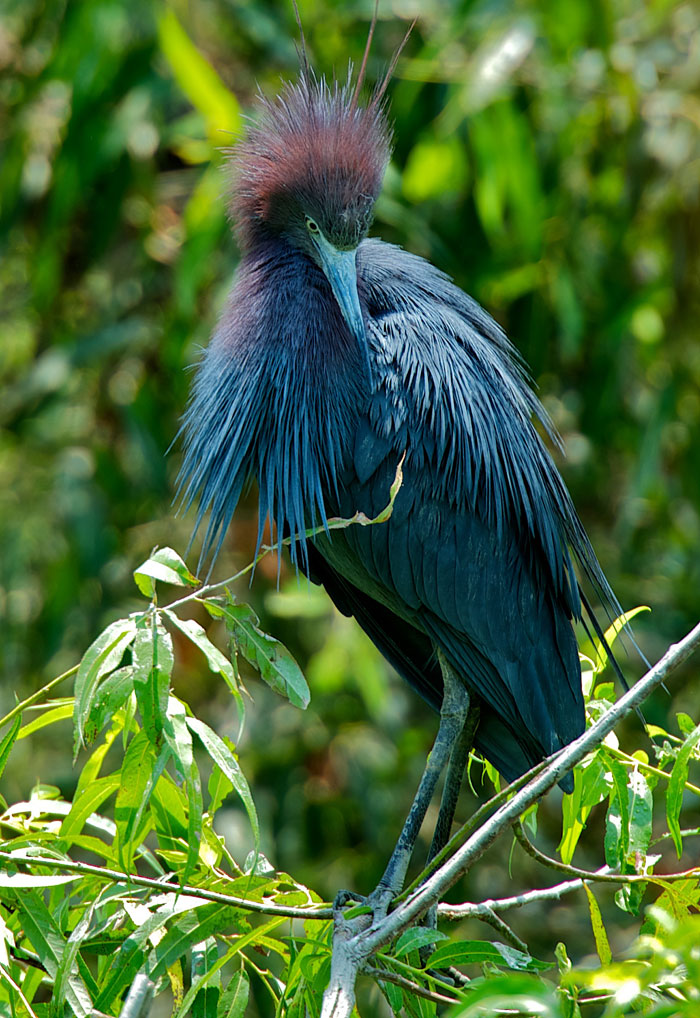
With striking slate-blue feathers on its body and muted maroon-purple feathers on its head and neck, it's hard not to notice a Little Blue Heron, especially when it shakes out those feathers!

This Little Blue Heron was watching over chicks in a nearby nest. He fluffed up his feathers and shook everything out, transforming into a little "regal" heron!

...his change is so rapid, it is almost like he slips on royal clothes.

...slowly morphing back into his "average joe" look.

...what a difference!

...here's another noticeable difference. When Little Blue Herons are chicks, they are white and remain so all through their first year. Hints of what's to come are visible, though--they have a small black tip on their bills, and small bits of darker gray or blue can be found at the tips of their wing feathers (but it's hardly noticeable).

Mother Nature always has a reason for her anomalies, and white morph immature Little Blue Herons are no exception. Turns out Snowy Egrets don't mind when baby Little Blue Herons hang out with them and fish. Maybe because the young birds are white, the Snowy Egrets ignore them, which is good for the young Little Blue Herons. For some reason, immature Little Blue Herons who hunt with Snowy Egrets catch more food! I found no definitive answer, but the most common reasoning was the Snowy Egrets hunt differently than Little Blue Herons and stir up more fish, making it easier for the Little Blues to catch dinner. Since the Little Blue Herons remain white for a year, they get a head start by fishing with Snowy Egrets. Because of that, you'll often find Little Blue Herons and Snow Egrets nesting together in rookeries...

A Snowy Egret nest is tucked into the Little Blue Heron section of the Ibis Pond rookery on Pinckney Island in South Carolina. Every year I've found Little Blues and Snowy Egrets nesting together at the Ibis Pond rookery.

For another post showing a Little Blue Heron in his "regal-ware," click here.
(Photographed on 6/6/2011 at Ibis Pond on Pinckney Island, SC near Hilton Head.)

For more information about immature Little Blue Herons and their white color morph, click here for the Cornell Lab of Ornithology's "All About Birds" site.

Thursday, August 25, 2011

How to fly in four easy moves...

I was watching this young Little Blue Heron flapping and stretching his wings, practicing for the big take-off, when I noticed he was mimicking his mama. If the adult would flap, the baby would too. If the adult reined it in, so would the baby. It was funny to watch, and the following imaginary scene of an adult instructing a child on the finer points of flight played in my mind...

"Okay, son, just do what I do, and you'll be golden..."

...you have to stretch those wings wide to produce enough air flow to create lift...

...wing position is critical for sharp turns...

...again...pay attention to that wingspan!

That was fun, ma! Can we do it again? Am I ready to fly yet? I felt great. How'd I look? Can we do it again?

I saw these two on June 8, 2011 at Ibis Pond on Pinckney Island near Hilton Head, SC. In addition to strengthening and stretching its wings to gain strength for eventual flight, the baby was getting used to perching on limbs instead of just sitting in the nest. A lot of wing flapping goes on in the rookery, and it's fun to watch!

Monday, August 1, 2011

When a Little Blue Heron puffs up...

...he really puts on a show! Of all the herons, the Little Blue seems to be most dramatic in his displays. He goes from mild mannered (almost dull) to spectacular in a single breath!


...puffed up and in full breeding plumage, a Little Blue Heron creates a huge splash of color and drama...

...ominous...

...contemplative...


...our mild-mannered Little Blue Heron's alter ego can not be held in check!


...a guardian among birds...


...able to leap anything he wants to!


...until he finally slips back into his mild-mannered Clark Kent in feathers character.


Photographed on 6/8/2011 at the Ibis Pond Rookery on Pinckney Island (Hilton Head, SC).
Click here for all the 2011 Pinckney Island posts.

Tuesday, June 30, 2009

Three Little Blue Heron Chicks at Pinckney Island National Wildlife Refuge (Near Hilton Head Island, SC)

Birding on Hilton Head Island and Pinckney Island NWF…continued from Sunday's post on the Little Blue Heron.
These Little Blue Heron chicks held me spellbound. They were so small they could barely keep their thunky heads upright on their spindly little necks, much less clamber around on the branches, but that’s exactly what they were doing. Climbing and stumbling over each other, they were not content to stay safely tucked away in their nest.

I might be hungry. I might want food.

I'm definitely hungry. I want food NOW!!!

These little chicks will remain white through their first year of life. Immature Little Blue Herons are unique in the heron world because of this first-year color morph. If you look closely you can see a dark blue-grey tipped primary feather on his wing. It's sometimes hard to see.

...can you see that blue-grey tipped feather here? It's a little harder to see in this photo.

Bock! I'm hungry!

Bock! Now I'm doing my rooster imitation. Time to get up!

Dude, can you ever just chill? Enough with the rooster imitation.

Quit pushing me. I want to see if these things work yet!

Beak Bit
Why do the chicks remain white during their first year? Click here to go to the Cornell Lab of Ornithology's "All About Birds" site. In their Cool Facts section, they explain Little Blue Herons often nest near Snowy Egrets and the Snowies tolerate the young more if they are white, plus the immature white-morphed Little Blues seem to catch more fish when they are with Snowy Egrets than when they are fishing alone. It just so happens that the neighbors of these three Little Blue Heron chicks were Snowy Egrets. In addition, the white Little Blue Herons can more easily blend in with larger mixed-species flocks of white herons, which offers them a little more protection from ever-present predators!

Sunday, June 28, 2009

Little Blue Heron at Pinckney Island National Wildlife Preserve (near Hilton Head Island, SC)

Birding on Hilton Head Island and Pinckney Island NWF…continued from Saturday’s post on the Green Heron.
I decided to stay and watch the Green Heron fish. Any bird who lays out bait to lure in his dinner deserves a little more attention, and I really wanted to watch him spear a fish, but my resolve was short lived as a dark blue bird gently glided over my head and clumsily landed in a tree halfway between Mr. Green Jeans and the Snowy Egret. It could only be one bird…a Little Blue Heron, and a Little Blue Heron was a life bird for me. With adrenalin surging all over the place, I scrambled over to where he landed. Holy Moly! Tucked in among the leaves was another Little Blue Heron, but this bird wasn’t alone. He was on a nest with three babies! Wow! That really focused me, and I started firing away right and left at the new species, so lovely and dark blue against the green leaves…