I could not believe my luck when I saw this small group of Wood Storks (
Mycteria americana). They were feeding in the shallows along the driveway to the
Pinckney Island NWR. It was my last day of vacation and I was leaving the park. I was glum and morose, and just like a kid dragging her feet, I was driving slowly with the windows open, watching the water and the grasses, trying to wring out every last bit of the island that I could. Leaving Pinckney is never fun, but suddenly,
zing! yes!! happiness!!! -- Wood Storks were feeding about 50 feet away in the shallows...
 |
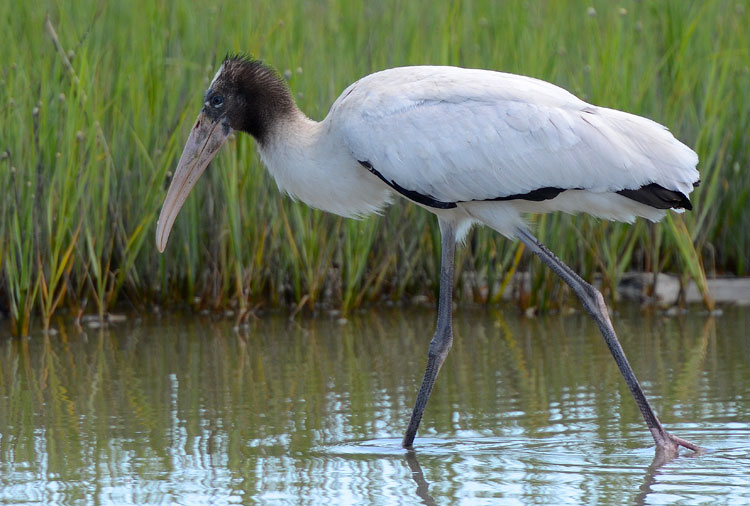
| A juvenile Wood Stork feeding in the shallows at Pinckney Island NWR in South Carolina. |
I pulled the car over and watched the small flock through the binocs. The birds were feeding, and I could see them stirring the water with their feet. They had their bills open in the water, waiting for a fish or crab to make contact. After a while, I got out of the car, crossed over and sat down behind the grasses. I remained still and quiet, and they went about their business of fishing and eating...
 |
| ...a juvenile Wood Stork fishes with his bill open, waiting for a fish or crab to make contact. |
Woods Storks have a unique way of catching their prey. They like to forage in shallow water with large concentrations of fish or crabs where they hold their bills open in the water. When a fish or crab makes contact with the bill, it triggers a snap-shut reflex, and the Wood Stork nabs its dinner without ever having to see into the murky water. Because Wood Storks are tactile feeders and do not have to see their prey to catch it, their method of feeding is called "grope-feeding" or "tacto-location."
Click here for a detailed explanation of this feeding method and other information on Wood Storks.
In the following video, you can see the Wood Stork stirring the water with its foot, then scooping up a little crab. At the end of the video, I put some of the action in slow motion to better see the Wood Stork eating a little crab...
 |
| A Wood Stork uses "foot stirring" to drum up some lunch. |
 |
| The Wood Stork is endangered in the United States, so I was especially happy to have been in the right place at the right time to see this small flock of Wood Storks...even if it was my last day of vacation. |
Wood Storks are doing well in Georgia and South Carolina, and the government is thinking about changing their status from endangered to threatened.
Click here for an NPR article and broadcast of the story.
 |
| Wood Storks are large birds. This guy was over three feet tall. I loved watching him move slowly through the water. |
 |
| An adult and a juvenile Wood Stork walk single file. The adult is on the left. Check out that bald, scaly, woody looking head. On the right is the juvenile Wood Stork, still fresh and new and covered in feathers. |
In part two of this series I'll focus on the adult Wood Stork's face, so you can see how different a juvenile and an adult look. I took these photos on June 19, 2012.





 Posts
Posts


