Tuesday, February 26, 2013

Wood Storks and their unique way of feeding...

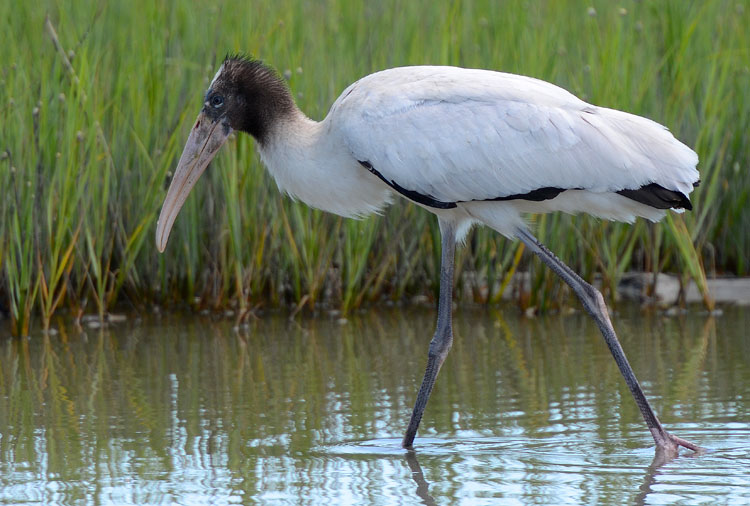
I could not believe my luck when I saw this small group of Wood Storks (Mycteria americana). They were feeding in the shallows along the driveway to the Pinckney Island NWR. It was my last day of vacation and I was leaving the park. I was glum and morose, and just like a kid dragging her feet, I was driving slowly with the windows open, watching the water and the grasses, trying to wring out every last bit of the island that I could. Leaving Pinckney is never fun, but suddenly, zing! yes!! happiness!!! -- Wood Storks were feeding about 50 feet away in the shallows...

Juvenile Wood Stork at Pinckney Island NWR, South Carolina
A juvenile Wood Stork feeding in the shallows at Pinckney Island NWR in South Carolina.

I pulled the car over and watched the small flock through the binocs. The birds were feeding, and I could see them stirring the water with their feet. They had their bills open in the water, waiting for a fish or crab to make contact. After a while, I got out of the car, crossed over and sat down behind the grasses. I remained still and quiet, and they went about their business of fishing and eating...

...a juvenile Wood Stork fishes with his bill open, waiting for a fish or crab to make contact.

Woods Storks have a unique way of catching their prey. They like to forage in shallow water with large concentrations of fish or crabs where they hold their bills open in the water. When a fish or crab makes contact with the bill, it triggers a snap-shut reflex, and the Wood Stork nabs its dinner without ever having to see into the murky water. Because Wood Storks are tactile feeders and do not have to see their prey to catch it, their method of feeding is called "grope-feeding" or "tacto-location." Click here for a detailed explanation of this feeding method and other information on Wood Storks.

In the following video, you can see the Wood Stork stirring the water with its foot, then scooping up a little crab. At the end of the video, I put some of the action in slow motion to better see the Wood Stork eating a little crab...


A Wood Stork uses "foot stirring" to drum up some lunch. 

The Wood Stork is endangered in the United States, so I was especially happy to have been in the right place at the right time to see this small flock of Wood Storks...even if it was my last day of vacation.

Wood Storks are doing well in Georgia and South Carolina, and the government is thinking about changing their status from endangered to threatened. Click here for an NPR article and broadcast of the story.

Wood Storks are large birds. This guy was over three feet tall. I loved watching him move slowly through the water.

An adult and a juvenile Wood Stork walk single file. The adult is on the left. Check out that bald, scaly, woody looking head. On the right is the juvenile Wood Stork, still fresh and new and covered in feathers. 

In part two of this series I'll focus on the adult Wood Stork's face, so you can see how different a juvenile and an adult look. I took these photos on June 19, 2012.

Sunday, February 3, 2013

A grumpy Carolina Wren demands mealworms...

While I was working in the kitchen earlier today, the strident scolding and squawking of a Carolina Wren caused me to look out back. "Oooops...sorry fella," I said through the glass. He was nonplussed with my response and scolded me some more, hopping from the peanut feeder, to the ground, to the table and back, just like a little kid stamping his feet and screaming for candy. You don't have to speak wren to know what he was saying...
"Gimme my mealworms, now!" 

A Carolina Wren hangs on a suet feeder. Usually he's happy with the suet treat, but when it snows, he demands mealworms.

Grumpy little thing....

...grumpier little thing!

A pouting Carolina Wren cannot be ignored, so I did what any well-trained bird lover would do. 
I got on my coat and boots and went out in the snow to refill the feeder!

Uhhhh ohhhh.....guess who else likes mealworms?
A Starling was the first bird to return to the deck after I refilled the mealworm feeder.

The Starling quickly snapped up the mealworms on the ground. 

...but no worries for the Carolina Wren. He knows I put mealworms in this tiny ceramic bird house. It's too small for a Starling to fit in, but a Carolina Wren can easily poke his head in and nab a mealworm.

...yes C.W., next time I'll do a better job keeping the mealworms replenished!

Click here for other posts over the years of our mealworm-eating Carolina Wrens.

Thursday, January 17, 2013

The silver feathers on an Anhinga's wings...or...baby's got bling!

When you seen Anhingas at a distance, they appear black, and you might not even know they carry a spectacular pattern of black and white (silver) feathers on their wings. When you're sitting right next to them, however, it's easy to see the "bling" on their backs...

A male Anhinga preening, showing off the striking pattern of black and silvery-white feathers on his wings.
This is the same Anhinga I talked about in two earlier posts that sat very close to me (click here for those close-up photos). Close viewing of the Anhinga's back let me study the beautiful pattern in his wing feathers (coverts and scapulars). I always thought these feathers were white, but up close, I could see they were silver...not white, not dull gray, but shiny silver!

The "white" covert and scapular feathers on an Anhinga are a glossy silver color. From a distance they appear white because of the contrast with the black feathers.
When I got home, I looked up Anhingas to see if they really did have glossy silver wing coverts and scapulars, or had I just imagined it. It turns out they do, and they owe their silver feathers to a special structure in the barbules of the feather. I found a detailed technical article published in the Journal of Morphology that explains why those feathers are indeed silver. Click here to read "Proximate Bases of Silver Color in Anhinga (Anhinga anhinga) Feathers," by Matthew D. Shawkey, Rafael Maia, and Liliana D'Alba.

...whether silver or white, the pattern on the back of an Anhinga is striking.
Bird feathers contain a center shaft called a rachis. Barbs branch off the rachis, and barbules branch off the barbs. The barbules run almost parallel with the rachis and hook together to make the feather strong.  The barbules in silver feathers are different--they are longer than those in other feathers, and they are flattened. Additionally, they twist a little, and one side is black and the other side is translucent. The twist means part of the translucent barbule is exposed, which creates the silver sheen. I found an article on the BBC Earth News site explaining the research of Dr. Ismael Galvan by Matt Walker called "Birds unveil 'silver wings'" (click here). This article is a little easier to understand than the technical research paper and clearly explains how the silver sheen appears on the feathers.

Galvan concluded that dark-colored birds evolved the silver sheen as a way to "become more colorful and conspicuous," while still keeping the benefits of dark-colored feathers (dark feathers contain the pigment melanin, which makes them stronger and protects the feathers from abrasion and UV radiation). 

This is the third part of the Anhinga series:
Part 1: Anhinga close-ups
Part 2: More Anhinga photos; spread-wing posture
Part 3: The silver feathers on an Anhinga's wings

Sunday, January 6, 2013

A little creeper in our backyard...

Our recent snows brought a new visitor to our backyard...a Brown Creeper (Certhia americana)! This cute mouse-like brown bird landed at the base of our half-dead weeping willow tree when I was standing about 20 feet away photographing Dark-eyed Juncos (click here for those shots). He efficiently and thoroughly worked his way up the tree, turning over loose bark and peering into crevices as he hunted out spiders and other overwintering insects and eggs. When he exhausted the willow tree, he flew over to the ash tree and worked his way up it...

Brown Creeper (Certhia americana) climbing up a Weeping Willow Tree in our backyard.
A Brown Creeper clings to the bark on the weeping willow tree in our back yard.

Brown Creeper (Certhia americana) using its tail as a prop.
I noticed the Brown Creeper was using his tail as a prop, much like a woodpecker does. 

That's a mighty fine pygostyle you've got there...
I recently read in the book Wild Bird Guides: Downy Woodpecker by Gary Ritchison, that the anatomical structure that allows woodpeckers to use their tails as props is called a "pygostyle." A cool name that stuck with me, because when I saw the Brown Creeper using its tail in the same posture, "pygostyle" popped in my head, and I wondered if a Brown Creeper's pygostyle was similar to a woodpecker's. After looking in a few books and doing a few Internet searches, I found it was.

How is it different?
The pygostyle in a bird is made from 4-10 fused posterior caudal vertebrae...basically, it's the bird's tail bone (like our coccyx). The pygostyle and the muscles around it give support to the tail feathers (rectrices), and while all birds have a pygostyle, not all pygostyles are the same. For example, the bones in a woodpecker's and creeper's pygostyle are much larger and the muscles surrounding it are much stronger than those in an average bird's tail. Most birds fly and perch on branches, but woodpeckers and creepers cling to and walk up the vertical surface of a tree trunk. Their tails help them stay in place because they work like a prop. Additionally, these types of birds have the adaptation of very stiff tail feathers, especially the middle feathers...all the better to lean on when clinging to or walking up a tree trunk. If you look closely, the middle feathers are also pointed and curve slightly inward to guarantee the tail makes solid contact with the bark (Ritchison, pg. 10).

Other birds have well-developed pygostyles too, for example, woodland hawks that use their tail feathers for precise steering through branches have well-developed pygostyles, and birds that use their tails for upward lift to help them hover, such as kestrels, do too.  If you'd like to see a labeled bird skeleton of the pygostyle, click here and look at #2. (However, if you've ever dressed a turkey or a chicken, you've already seen the pygostyle! It's the "Pope's nose" or the "parson's nose," the colloquialisms for the fleshy triangle at the tail.)

Brown Creeper (Certhia americana) checks out an abandoned woodpeckers hole.
While spiraling up the tree, our little Brown Creeper popped into an exposed and abandoned woodpecker's hole for a few seconds before continuing on. It's unusual to see a Brown Creeper standing out so well. Usually their camouflaging colors and patterns make them invisible against the bark. They are no match for the inside of a tree!

Brown Creeper using its tail to help it stay on the tree.
It's easy to see how the Brown Creeper makes good use of its tail. The pointed tail feathers are stiff like a Downy Woodpecker's and when combined with the strength of a well-developed pygostyle and muscles it becomes a very good prop and helps the bird cling to the tree trunk's vertical surface. 

This little brown bird is often hard to spot, and is often described as being a small piece of moving bark!
It's always fun to spot a Brown Creeper. They blend into the bark so well sometimes it's hard to see them. I usually hear their ultra-fine peeping and then watch until I see a little movement. Their habit of spiraling up a tree and then diving down to the base of the next tree helps a little when looking for one. 

...just like woodpeckers, this bird has evolved a well-developed pygostyle, stiff tail feathers, and inward curving tail feathers to help it cling to vertical surfaces.
...here you can see the inward curve on the Brown Creeper's middle tail feathers. 

Closeup of the extra-long hind claw or back toe nail on a Brown Creeper.
...another adaptation, Brown Creepers have extra long back toe nails, or hind claws, to help them hook into the bark. 

p.s.
The snow blew in another backyard favorite, our American Tree Sparrows (Spizella arborea)! Every year I wait for them to show up, but they never seem to arrive until snow or a severe cold snap moves in. I saw two on Wednesday....exciting. I love the tinkling, sweet calls of a flock of American Tree Sparrows.  This afternoon Rick and I went to Armleder Park to look for longspurs, we didn't see those, but we did see and hear hundreds of American Tree Sparrows...what a magical sound!
Click here for an older post on American Tree Sparrows--a favorite winter visitor.

Thursday, January 3, 2013

Ol' Blue is at it again...

While Red sits in the snow eating sunflower seeds, Ol' Blue continues to work hard to get me to change the name of the blog. "Blue and the Peanut is much more appropriate," says he…over and over…

Blue Jay pulling peanuts out of the peanut feeder.
"Blue and the Peanut!"

Blue Jay pulling peanuts out of the peanut feeder.
"Blue and the Peanut!"

Northern Cardinal eating sunflower seeds...and keeping an eye on me on the other side of the window!
"...mmmmmm, sunflower seeds!"

Northern Cardinal eating sunflower seeds...and keeping an eye on me on the other side of the window!
"...mmmmmm, sunflower seeds!"

Northern Cardinal eating sunflower seeds...and keeping an eye on me on the other side of the window!
"...mmmmmm, sunflower seeds!"
I'm starting to think he might be right...

Tuesday, January 1, 2013

Our snow birds are happy...

...because we have snow! What a perfect way to start the new year. It seems the persimmon seeds we cracked open this autumn were right...

A Dark-eyed Junco (Junco hyemalis) in the snow...the first bird of 2013!
I took these photos a few days ago when the snow first fell, but they fit perfectly with today's post because a Dark-eyed Junco was the first bird Rick and I saw this morning. Three little junkies were hopping on the deck, eating seeds I scattered last night.

A male Dark-eyed Junco sitting in a young mulberry tree as snow falls softly.

...after rooting for seeds in the snow, this little female comes up with a snootful!
A female Dark-eyed Junco with a bill full of snow!

A sweet female Dark-eyed Junco roots in the snow for seeds.
...a snow bird on a snowy day.

Wishing everyone a Happy New Year!
...and all the best for 2013!


...for past First Bird of the Year posts, click here.

Thursday, December 27, 2012

"How did you come up with that idea?" ...and winter roost boxes for the birds...

I had nine people ask me how I came up with the idea for my Christmas card "Chiggy decks the halls" this year, so I thought I'd show the process. Sometimes an idea pops right in my head, and I know exactly what I want to paint, but this year I wasn't so lucky. I was panicking because I only had a few days to create my card, and I had tons of ideas in my head but couldn't get anything to solidify. When that happens, I step back, get out the pencil and just sketch. Creating lots of tiny sketches that take only seconds to draw warms you up and lets ideas flow out. I did have a little direction in mind when I started: "Chiggy" was a favorite bird of my Aunt Pat, so to keep her in my heart this Christmas, I let lots of little chickadees appear on the page...

...when your brain is frozen, start drawing tiny sketches that take only a second or two to complete. It helps warm you up and lets your ideas flow.
...tiny sketches of chickadees done quickly helped me zero in on an idea for my Christmas card. I knew as soon as I drew the chickadee on the birdhouse in the bottom-right corner I had my design.  
Even though I knew my card design would be based on a birdhouse with a chickadee and a wreath, I didn't know exactly what it would look like, so I got out a few pieces of scrap paper to start developing the idea. First came Chiggy with an ornament...

Scrap paper is a great way to develop ideas. You don't care what happens to the image if it is on a piece of paper headed for the recycle bin!
Scrap paper is great for developing ideas. You don't care what your sketch looks like when it's on a piece of paper headed for the recycle bin, so you're free to experiment. The ornament in this sketch just didn't feel right, so I put it aside and pulled out another scrap of paper...

Pencil sketch for idea #2. It didn't work. It just didn't look like something Chiggy would do!
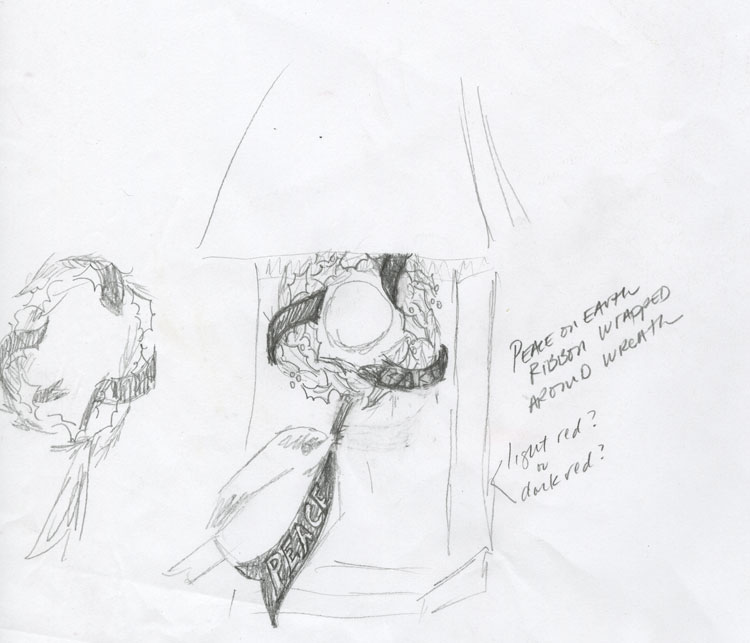
...this design was a little better. Still, the ribbon didn't work. I liked the bird on the left side holding a sprig of holly...but...

Pencil sketch for idea #3. It didn't work either.
...I went back to the ribbon idea. Maybe if he was pulling the ribbon around the wreath...but it still wasn't right.

Pencil sketch for idea #4. I like it. Nice and simple and even "likely."
...finally went back to the sprig of holly. It was more natural and seemed like something a Chiggy might do. But the idea of Peace on Earth was still in my head....maybe a ribbon on top like a banner....but nahhh. Just didn't work. It was best to keep the image simple and focus on the holly and pine rope. That image told a story and said it all.

The first stage of this year's Christmas card, "Chiggy Decks the Halls." Original watercolor painting by Kelly Riccetti.
...the first round of watercolor. Normally I don't scan the stages of my paintings, but when I'm not sure where to go next, or I'm worried I might ruin it, I often scan as I go.

The second stage of this year's Christmas card, "Chiggy Decks the Halls." Original watercolor and gouache mixed-media painting by Kelly Riccetti.
...a second layer of watercolor to soften up the roof, add a bit of detail to the wood, and add the dark night sky; followed by gouache highlights on the white feathers and the green leaves, plus a rough layer of dark orange colored pencil on the rusty roof for a bit of texture. 

The final version of "Chiggy Decks the Halls," an original watercolor and gouache mixed-media painting by Kelly Riccetti.
...then the snow...first a watered-down splatter of white gouache to add depth, next snowflakes painted in a thicker mix of gouache to create the mid-field view, and finally dots of snow in a much thicker and brighter mix of gouache to bring them to the foreground...and that's the final painting. 
So if you're trying to design a card and the creative part of your brain is frozen, don't panic. Start drawing images that take only a few seconds to complete. Don't think about them, just let them flow from your pencil. Drawing quick little images warms you up and melts the frozen part of your creative brain.

p.s.
Does anyone recognize the birdhouse I used in the card? If you've ever been to a Southern Living party, you might have seen it in the catalog. I bought it years ago at a Southern Living party, and it sits out on my deck. Often when I draw a birdhouse, it's what pops in my mind. I love it's vintage style and the way the roof has rusted...

...the model birdhouse for this year's Christmas card. I bought it at a Southern Living party years ago.
Our Southern Living birdhouse...well weathered and beautiful.
p.p.s.
I hate to admit it, but even though I finished the painting on time, my card didn't go out on time (my cards still haven't gone out). I was swamped at work, and I got sick. Boo! My cards are going out as Happy New Year cards this year. Maybe I'll tape a 2013 banner on the roof...

one more thing....in winter, cavity nesting birds (like our little chickadee) use roost boxes to help them conserve heat and make it through the long, cold winter nights. Click here for a post explaining the importance of roost boxes and how to make them.