Saturday, March 31, 2012

Gobble, gobble, gobble...wait, it's not Thanksgiving, it's spring!

...but spring is the perfect time to listen for gobbling Toms and witness their incredible courtship displays, and thanks to conservation and restoration efforts, it's much easier to find them in the woods now...

A male Wild Turkey (Meleagris gallopavo) walks in full regalia as he puffs his feathers up in a courtship display. He really does have an air of royalty as he glides through the brown leaves, wings dragging the ground, and his iridescent green, bronze and gold feathers catching the light perfectly for maximum effect.

In early spring, when winter's leaves are still brown and crackle underfoot, male turkeys start strutting for females. It's an image we usually think of at Thanksgiving, but spring is when you usually see it!

...every emotion a turkey has shows on his face where "mood colors" of bright red, blue and white can change in seconds when hens or other toms are around (source: "Birds of Forest, Yard, & Thicket," by John Eastman, pg. 7).

Turkey lingo! The skin that hangs from a turkey's beak is a snood. The bumpy, wart-like projections on the skin...caruncles, and the crazy rope of feathers that hangs from his chest...a beard! What's a group of turkeys called? ...a rafter or a gang (source: USGS).

This gobbler (male turkey) had 6 hens in his harem, but they weren't interested in his strutting and displaying, and most, like this hen, walked away non-plussed.

Turkeys roost in trees at night. They also will fly up to trees when startled (or when they hear a camera shutter click...). This female flew effortlessly up to branches about 30 feet off the ground. She remained there for about 10 minutes before deciding to fly back down and join the foraging flock.

Courting Toms take their job seriously. I watched this male and the six hens in his harem for over 45 minutes. Only once did he let his feathers down, and that was only for a second or two. While the females foraged and ate seeds, the male never once tried to eat. This behavior was confirmed in Eastman's "Birds of Forest, Yard, & Thicket," pg 7, where he writes, "Belligerent toms strut and display in spring, sometimes hardly feeding for days at a time."

I love the return of the Wild Turkey. When I was a kid, turkeys were not in any woods I ever played in. For me they were birds that showed up on Thanksgiving decorations and only took the form of a male in courtship display. According to "The Birds of Ohio," by Bruce Peterjohn (pg. 143), Wild Turkeys were extirpated from Ohio by 1900, so no wonder I had never seen one in the wild, but in February of 1956, Wild Turkeys were released in southeast Ohio. In the 80s they were released in the glaciated counties, and in the 90s, in the central and western counties. For the past three years I have heard and seen them regularly along the Little Miami River. Before then, I saw them once about eight years ago along the bike trail. They are skittish birds and can disappear into the brush and woods with amazing speed. I saw this rafter of turkeys in Tennessee on the Cumberland Plateau in the woods behind my mother- and father-in-law's home last week when Matty and I headed down for spring break.

Friday, March 30, 2012

Savannah Sparrows singing in the meadow...and the warbler countdown begins!

Last Saturday I met Paul and Joe at Armleder Park in Cincinnati to photograph Midland Smooth Softshell turtles at the Little Miami River (about 30 miles south of where I usually walk the Little Miami), but in the huge meadow between the parking lot and the river, two species of returning migrants had already taken up residence...Savannah Sparrows and Vesper Sparrows! This pair of Savannah Sparrows looked very sparrow-ish in the tall grasses and took turns diving down to the ground and flitting here and there among the dead stalks left over from winter...

Two Savannah Sparrows (Passerculus sandwichensis) perch in the large meadow at Armleder Park in Cincinnati. Vesper Sparrows were nearby, and Tree Swallows dipped and dived through the grasses before returning to the nest boxes set out along the trail.

A bubble of music floats
The slope of the hillside over;
A little wandering sparrow's notes;
And the bloom of yarrow and clover.
--Lucy Larcom
(as referenced in "Music of the Birds," by Lang Elliott)

I laughed when photographing these two. They were like little kids. "Could you both look at the camera at the same time, please?"

...maybe!

It's so fun to watch the summer birds arriving little by little. Soon the warblers start! This May I'm heading up to Magee Marsh and the Black Swamp Bird Observatory for the Biggest Week in American Birding! Finally...I'm going to see the spring warbler migration on Lake Erie. I'll be blogging there too (more posts about that soon). The warbler countdown begins!!

:-)
If you're headed to Lake Erie for spring migration let me know!

Saturday, March 24, 2012

What's fuzzy, yellow, and looks like a beetle but buzzes like a bee?

...a Bumble Flower Scarab Beetle (Euphoria inda) of course! (As if I knew that...) This cool bug is another for me that fell into the "what the heck is that?" category...


A Bumble Flower Scarab Beetle (Euphoria inda) clings to a sign at a nature preserve in Fairfield Glade, Tennessee.

When you look closely at this bug, you find a a fuzzy, yellow beetle with maroon stripes on its abdominal segments. It sort of looks like a moth whose wings took a turn for the worse, but really the body is not moth-like at all. It has armor plating like a beetle...a scarab beetle to be exact, and its antenna are definitely not feathery like a moth's but instead have plate-like lamellae at the end like a beetle's. The elytra (the hard outer wings that protect the hind wings) have a mottled brown, yellow and black pattern on them, and even though they are also a bit hairy, really show it's a beetle. Matty, Ron (my father-in-law), and I studied this guy for a while trying to figure out what he was. Eventually we moved on in search of a few caves, and I took a few quick shots so I could go back later and ID him...

This Bumble Flower Beetle must have just woken up from his long winter's nap and crawled out of the spot where he overwintered. It was warm, and he seemed to be soaking up a little sun.

...turns out, I didn't have to ID him. My friend, Paul Krusling, knew what he was and sent me a link to the hairy bug on BugGuide.net (click here). I wonder how many other people out there were not familiar with Bumble Flower Beetles? If he were a rare bug, I'd feel better not having known what he was, but he's not. He's one of the most common members of the scarab beetle family! However, I may have seen him before but just didn't know it. The Bumble Flower Beetle gets his name because when he flies, he looks and sounds like a bumble bee. So maybe you've seen one too without knowing it!

(Matty and I just returned from a little spring break in Tennessee visiting my mother- and father-in-law in Fairfield Glade, about an hour west of Knoxville. I'll have a few more posts about springtime in Tennessee over the next couple of days.)

To learn more about the Bumble Flower Beetle (Euphoria inda), click here for a cool fact sheet from Utah State University.

Thursday, March 22, 2012

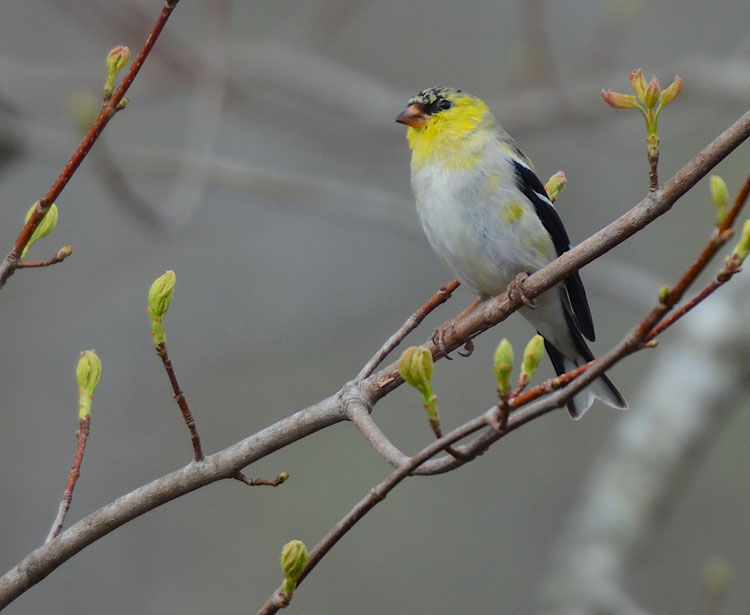
Scruffy Chic...the must-have spring wardrobe choice for happenin' male goldfinches...

Yet another sign of spring--from the changing of the guard to the changing of the wardrobe...

Male American Goldfinches (Spinus tristis) everywhere have started undergoing their spring molts.
Before you know it Scruffy Chic will be out of style and Sleek Yellow will be in!


Wednesday, March 21, 2012

The seasonal changing of the guard...

Yesterday evening, a lovely Chipping Sparrow (Spizella passerina) flew into view and perched in an outer branch of a tree at the edge of the woods. He was sweet and sat there looking at me with his rusty red cap at a jaunty angle--almost seeming to ask me if I was ready for the excitement of spring to begin. Around here, Chipping Sparrows signal the change of the season. Soon the little American Tree Sparrows (Spizella arborea) that flew in on a cold wind last autumn, will head north, and the other winter birds like the Dark-eyed Juncos will go with them...it's the seasonal changing of the guard!

A Chipping Sparrow (Spizella passerina) sits pretty at the edge of the woods and lets me know spring is about to be sprung!

Chipping Sparrows flit in and out of bushes around our house all summer long. I see them constantly nipping at grass seeds and hear their happy summer chatter. They are the perfect summer counterpart to the winter American Tree Sparrows!

Monday, March 19, 2012

The first snake of spring...a Queen Snake (Regina septemvittata)!

Matty and his friend, Kedar, were exploring the stream that flows out of Pine Hill Lakes in Warren county, when they came across the first snake of spring...a Queen Snake (Regina septemvittata)! In autumn we gage the change of seasons by watching for our first Dark-eyed Junco, but in spring, we watch for our first snake. Last year, I won, spotting an Eastern Garter Snake on April 22 (click here for that post). This year, Matty won...

Matty holds his first snake of the season, a Queen Snake (Regina septemvittata). This is the earliest we've ever seen a Queen Snake out and about in the water. (These photos aren't bad! Kedar took them using Matty's iPhone. Matty definitely has a little me in him. He knew I'd want a few photos for the blog..)

Queen Snakes are aquatic and nonvenomous. Matty and Kedar found this snake by flipping rocks in the stream. Queen snakes are dark brown or olive on top with a yellow or honey-colored stripe along their sides. Underneath, they have a pair of dark stripes on their belly. The belly stripes are diagnostic and make it easy to distinguish them from garter snakes.

This little Queen Snake was very friendly and didn't even musk on Matty.


...a one-second video of Matty holding "Regina" the Queen Snake (it was one of those you think you're going to take a photo, but the video was left on videos). I wish they had taken an actual video. I love watching the snake's movement.

Saturday, March 17, 2012

American Rubyspots (Hetaerina americana) along the Little Miami River

...continued from the previous post (click here).

Flashy male and female American Rubyspot (Hetaerina americana) damselflies were even more abundant than the Powdered Dancers (Argia moesta) featured in the previous post. Everywhere I looked the striking red metallic males were either flying over the water or perching on water willow (Justicia americana), their telltale ruby red wing spots easily giving them away...

The red metallic thorax and head of the male American Rubyspot (Hetaerina americana) damselfly flashed in the early evening sun. I was videoing the damselflies that night instead of photographing them. I wish I had taken a few good photos so I could have gone back to study the detail of the yellowish-gold sutures and the yellow veining that shows in the gorgeous red wing patches. This photo was an accident. I toggled the video switch off without realizing it. Wish I had taken a few photos instead of just videos (but I wanted to capture their movements so I could watch them in the winter)!


Male American Rubyspot damselflies along the Little Miami River. It was so nice to just sit and watch these jewel-toned damselflies. The sun was still very warm and the cicadas very loud, their song racing through the river valley in waves...

(If the video does not show on your screen, click here for a direct link to Vimeo.)


Female American Rubyspots are just as charming as the males, but they shine with orange and green highlights instead of the deep ruby red.

(If the video does not show on your screen, click here for a direct link to Vimeo.)

I took these videos on July 30, 2011 between 7:00 and 7:45 p.m. along the Little Miami River in Warren County. This area of the Little Miami Trail near the powder factory is an excellent place to watch damselflies. It's easy to get down to the rocky banks there, and massive patches of water willow can be found...both of which attract these beautiful insects.