Monday, October 31, 2011

Listening for our Great Horned Owls this winter...

On cold winter nights in December and January, I often listen for our local Great Horned Owl couple as they hoot back and forth from the treetops, calling out to each other in amorous devotion. All is quiet outside when they come through our neighborhood, and their sleepy and soothing calls flow easily in on the cold air. As I kneel beside the open window, looking out into the night, I always hope to see one fly by the window or see a silhouette of one perched against the moon, but I never do. These night creatures are for hearing only it seems, but in the cold and quiet of a winter's deep night, hearing is enough, and it might even be best because I see them through the sparkly eyes of moonlit imagination. Tonight the temperature will dip into the 30s again, and when I wake a hard frost will cover the plants and rocks and any other objects that got in its way, reminding me that I'll soon hear our two owls outside my window as they travel through the cold night...

Great Horned Owl (Bubo virginianus)
This owl's name is Sylvester, and he is another of RAPTOR, Inc.'s education birds. He's been around for a while, having been rescued in 1997. He was found with wing and leg fractures at the Lawrenceburg exit of I-275...hit by a car. Adult Great Horned Owls really have no natural enemies. Even a Bald Eagle will think twice before nesting in a Great Horned Owl's territory, so it was no surprise to see this bird was injured by humans. With its huge talons, it is one of our most powerful birds of prey. Sylvester is 22 inches long with a wingspan of 4 feet...needless to say, he was impressive sitting on the perch in front of us.

Great Horned Owls live in North America year round, but in our yard we usually only hear them hooting back and forth in late November, December, and January. This is when their courtship, which can start as early as September, really picks up. By January they have set up their territory and have selected their nest site. The female can lay eggs as early as mid or late January. Once the eggs are laid, the vocalizations calm down, and their calls become sporadic. We think the couple that visits our yard is a young pair. The first time we heard them hooting back and forth was January 12, 2009. In 2010 they became regulars. I hope they return to the same territory, and we get to hear them again this winter.

I had never heard the Great Horned Owl's nickname of "Cat Owl," but it was pretty easy to figure out where the name came from. The tufts of feathers that form the "horns" on their heads look like cat ears. Of course the ear tufts are not ears at all. The owl's ears are on its face, hidden beneath feathers and located below and behind the eyes.

Huge eyes...
A Great Horned Owl's eyes are about the size and weight of a human's eyes, but proportionately they take up a larger part of their face. If we compare our eyes proportionately to a Great Horned Owl's, they would be the size of tennis balls! (Source: "Intriguing Owls, Exceptional Images and Insigt" by Stan Tekiela, pg. 22.) Another difference, an owl's eyes are tubular shaped, not round like ours. The added length in the eye from front to back increases the focal length, which means the image appearing on the retina is larger than on a round eye. This is like walking around with a built-in telephoto lens (Tekiela, 23).

40% of all owls have ear tufts. The tufts work to help conceal the bird by fragmenting the outline of its body...or by simulating the top of a broken tree branch. Researcher Denver Holt (founder of the Owl Research Institute) studied owls with ear tufts when they were in the presence of a dangerous predator such as a cat. The owls immediately raised their ear tufts and even constricted their body feathers to appear thinner and taller, mimicking a branch (Tekiela, 62---if you're looking for an interesting book on owls, Tekiela's book, "Intriguing Owls, Exceptional Images and Insight" is a fantastic book. It's packed with interesting facts like this, plus phenomenal photos. It's one of my favorite owl books.)

"Tiger Owl"--another nickname I had never heard of! It's easy to see where it comes from, though. The colors and stripes of the feathers on the owl's belly resemble a Bengal Tiger...or maybe it's called a Tiger Owl because it's so ferocious when it's hunting!

My son read "Walden," by Henry David Thoreau this summer, so when he was finished with it I picked it up to re-read it. When I came across the following passage (Chapter XV: Winter Animals), I knew the quote would eventually end up on the blog. With November and winter fast approaching, it fits our Great Horned Owl couple perfectly...
"For sounds in winter nights, and often in winter days, I heard the forlorn but melodious note of a hooting owl indefinitely far; such a sound as the frozen earth would yield if struck with a suitable plectrum, the very lingua vernacula of Walden Wood, and quite familiar to me at last, though I never saw the bird while it was making it. I seldom opened my door in a winter evening without hearing it; Hoo hoo hoo, hoorer, hoo, sounded sonorously, and the first three syllables accented somewhat like how der do; or sometimes hoo, hoo only."
Many versions of Walden are available online. If you don't have a copy of the book at hand but want to read this chapter, click here for a link to Wikisource.

Note: RAPTOR, Inc. is a non-profit organization committed to the preservation of birds of prey. RAPTOR stand for the Regional Association for the Protection and Treatment of Raptors. Members of RAPTOR, Inc. rehabilitate and care for injured birds of prey until they can be released back into the wild. Click here for RAPTOR, Inc.'s HackBack newsletter and to learn how to donate to the organization, volunteer, or sponsor a banded raptor.

Monday, October 24, 2011

The beauty of a Barn Owl...

...continued from the previous post of Priscilla, the Barred Owl.
Storm, the Barn Owl, made her appearance with a raucous flourish any Barn Owl would be proud of--unrelenting screams! The first time I heard a Barn Owl scream was in 1990. Rick and I lived in Maineville back then, and barns still dotted the countryside. Our second-floor bedroom hung beside a grove of towering pines that bordered a farmer's field. It was cold out that night, but for some reason we had opened the windows so we could listen to the wind in the pines. The screaming started at about 4:00 a.m. "OMG...is someone being murdered? That sound can't be human...are Banshees real?" The eerie night sounds started to fade, and it finally dawned on us that we were listening to two Barn Owls calling to each other in the pines outside our window. The calls were amazing and terrifying, and I loved hearing them...

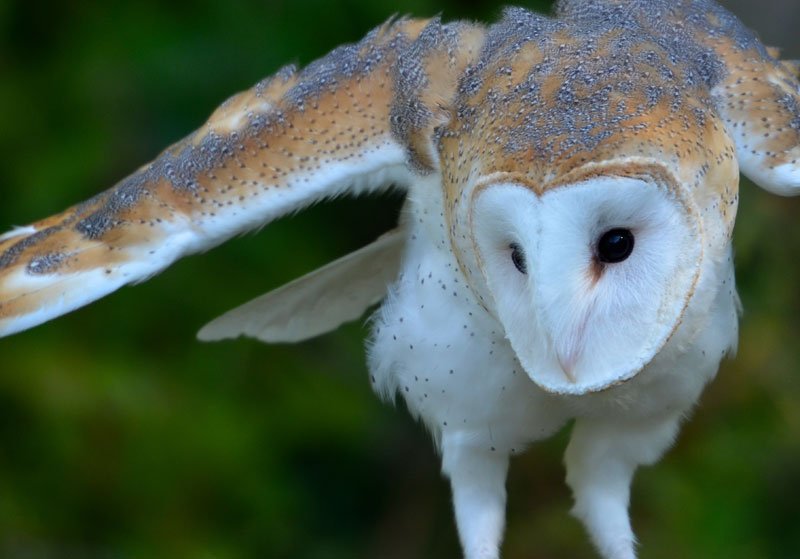
Storm, the Barn Owl, making her (or maybe "his") appearance...punctuated with an exclamation mark!

Storm is gorgeous. I've always thought Barn Owls were beautiful, but seeing one up close blew me away. The colors in her feathers are carmelly warm and rich, and her heart-shaped face is extraordinary.

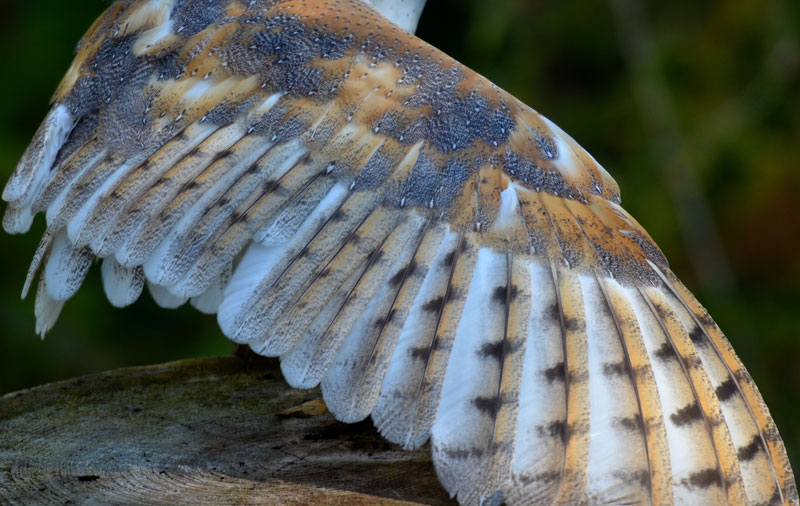
...I couldn't get enough of the patterns and colors in her wings and feathers.

...this is Storm's good wing, her other wing is partially amputated. She got it caught in a barn door, and it couldn't be saved.

...she backs up her beauty with terrifyingly sharp and strong talons.

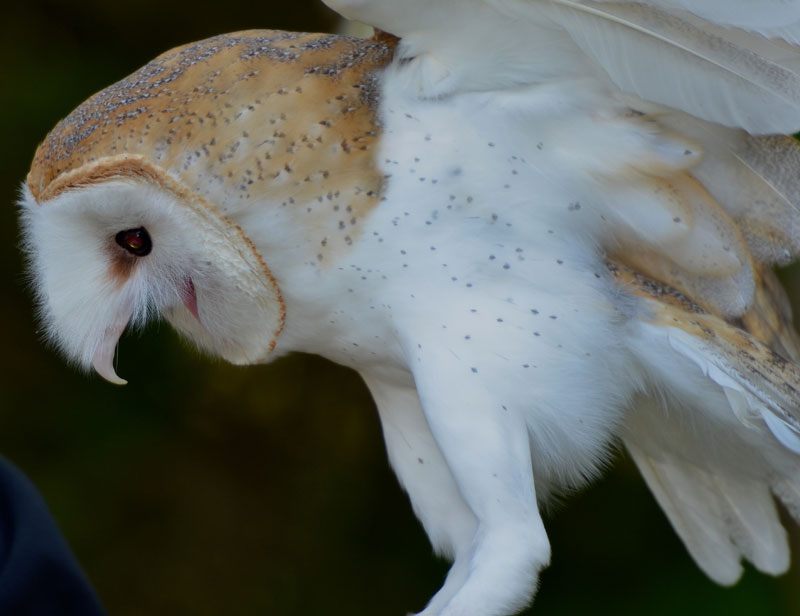
...snowy white feathers tipped in carmel.

...beautiful.


RAPTOR, Inc. is a non-profit organization committed to the preservation of birds of prey. RAPTOR stand for the Regional Association for the Protection and Treatment of Raptors. Members of RAPTOR, Inc. rehabilitate and care for injured birds of prey until they can be released back into the wild. Click here for RAPTOR, Inc.'s HackBack newsletter and to learn how to donate to the organization, volunteer, or sponsor a banded raptor.
Sunday, October 23, 2011

The soulful eyes of a Barred Owl...

...this morning Matty and I had the rare opportunity of photographing a few of the world's most beautiful and interesting birds of prey. Being able to stand within arm's reach of these amazing predators and see the detail in their ever-vigilant eyes, or the pattern and flow of their camouflaging plumage, or the curve and strength in their efficient talons stirs emotion—especially when you know the only reason you can stand so close to them is because they have been injured (usually do to human interaction) and can no longer fly free. My friend, Rick Hartigan of Nature Trek Photo Safaris, who is also the organizer of the Ohio Valley Camera Club, invited us to a special meetup he put together with Raptor, Inc. to photograph and study these gorgeous raptors...

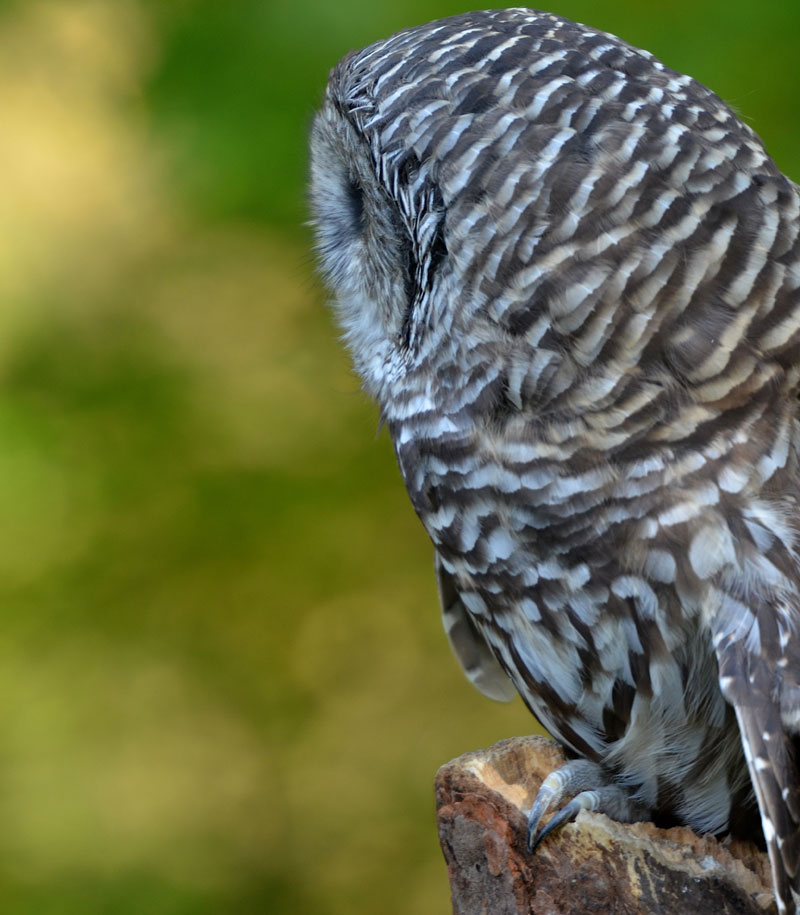
With large and dark eyes, a Barred Owl's soulful gaze catches our hearts...

...and even though many say anthropomorphizing is egotistic and fantastical (a product of a human's attempt to see the world through his own thoughts and feelings), would any other word work here?

...because even if this Barred Owl is not "soulful" (we have no idea what her thoughts are), we react with a soulful intensity when we look into her eyes, so what does it matter?

She has the ability to produce great, deep and wise emotions within us, and for that I am thankful...


Priscilla, the Barred Owl...

Priscilla was admitted to RAPTOR, Inc. back in 2007. She was a victim of a car strike, sustaining a left wing fracture at the elbow. Most of the birds that flow through RAPTOR are treated, rehabbed, and released back into nature, but some can never heal from their injuries and stay on as permanent residents and working birds. RAPTOR, Inc. is a non-profit organization committed to the preservation of birds of prey. RAPTOR stand for the Regional Association for the Protection and Treatment of Raptors. Members of RAPTOR, Inc. rehabilitate and care for injured birds of prey until they can be released back into the wild. If you're a Cincinnati birder, you probably already know that Susan Williams of Susan Gets Native is the Education Program Director at RAPTOR, Inc. Click here to see all of her posts and inside scoops on the permanent residents and working birds at RAPTOR. Click here for RAPTOR, Inc.'s HackBack newsletter and to learn how to donate to the organization, volunteer, or sponsor a banded raptor.
Thanks to Rick for inviting Matty and me to the shoot--we had so much fun, and thanks to Mark and Cindy Alverson for showing us the birds. I LOVED every minute--even when Earl the Vulture yacked up his rat! I'll have lots more posts this week of the amazing birds at RAPTOR...

Friday, October 21, 2011

...he forgot to run!

..this little sanderling dared to be different. Instead of running from the wave, he stood his ground. I think he thought the water a little cold...

A Sanderling waits for a wave to sweep past it on Captiva Island, March 22, 2011.

"Whoa!"

The following excerpt by Peter Matthiessen from "The Wind Birds" captures the heart of a Sanderling so well (taken from "The Bedside Book of Birds--an Avian Miscellany," by Graeme Gibson. This book is a collection of bird stories, art, and poetry that I love.)
"The sanderling is the white sandpiper or "peep" of the summer beaches, the tireless toy bird that runs before the surf. Because of the bold role it plays in its immense surroundings, it is the one sandpiper that most people have noticed. Yet how few notice it at all, and few of the fewer still who recognize it will ever ask themselves why it is there or where it might be going. We stand there heedless of an extraordinary accomplishment: the diminutive creature making way for us along the beaches of July may be returning from an annual spring voyage which took it from central chile to nesting grounds in northeast Greenland, a distance of 8,000 miles. One has only to consider the life force packed tight into that puff of feathers to lay the mind wide open to the mysteries--the order of things, the why and the beginning."

Thursday, October 20, 2011

A Pied-billed Grebe Couple at Ding Darling...

...when Matty and I saw these two Pied-billed Grebes swimming side by side, we thought it was a mama and a baby, but then we did a second take. It was only March 22, which seemed a little early for a baby to have matured to this size. When we looked through the binocs we were really stumped. The "baby" had the breeding plumage of an adult. I know males can be a little bigger than females, but this strange couple must have been made up of the biggest of big males and the smallest of small females...

...when we watched this couple from the bank, the size difference seemed much larger than what was captured in the photo, but even here, you can see how much bigger the male was. The female really did look like a juvenile. I don't get to see breeding pairs very often. I usually only see single birds when they are migrating through and floating solo, so maybe this is a normal size difference.

...we saw this Pied-billed Grebe couple at the J.N. Ding Darling National Wildlife Preserve earlier this year in March.

...pencil sketch of the mismatched Pied-billed Grebe couple (the size difference is slightly exaggerated in the sketch, but in real life, the male looked much larger as appears in this sketch--compared to how he appears in the photos).

Painting 179. Pied-billed Grebe Bright
(oil pastel)

Painting 178. Pied-billed Grebe Blue
(watercolor)
After I painted the painting, I took a spray bottle and sprayed the whole thing, letting the colors mix and drip down the page. It was painted quickly and sprayed before the paint had totally dried.

Painting 177. Pied-billed Grebe Light
(watercolor)

Tuesday, October 18, 2011

Chestnut-sided Warbler paintings...

Chestnut-sided Warblers are always a fun warbler to watch. Their bright yellow heads and rusty-chestnut sides always look so nice through the binocs! I continue to plug away on the 100 Painting Challenge (2nd year). I finished these paintings a few weeks ago and posted them to the challenge site and the Birding is Fun site, but forgot about old Red. So here they are...

Painting 176. Tough Chestnut-sided Warbler on the Lookout
(watercolor, charcoal, and an electronic PhotoShop Filter)

...pencil sketch of the Chestnut-sided Warbler

Painting 175. Chestnut-sided Warbler Migrating Through...
(watercolor, charcoal, salt for the mottled background, and an electronic PhotoShop Filter)

...pencil sketch for painting 175

Painting 174. Chestnut-sided Warbler in the Forest
(oil pastel over a quick watercolor)
(...this is my favorite!)

Painting 173. Chestnut-sided Warbler on Branch
(...a quick practice painting to plan painting 174. It is colored pencil over a two-minute watercolor.)

Monday, October 17, 2011

Baby Downy Woodpeckers visited us this summer...

This summer two baby Downy Woodpeckers spent a lot of time in our backyard and outside my kitchen window. It was a special time watching the babies learn how to hunt insects on their own and nab peanuts from the peanut feeders. Hopefully I'll see them through the winter...

...a sleepy-eyed baby Downy Woodpecker rests on a dead willow branch to watch what was going on around her (later during the summer, the entire dead section of the tree, including this branch, came tumbling down. During the winter our Cooper's Hawk and our Red-shouldered Hawk perch in the dead tree, giving us fantastic views of them, but no more. We already miss the dead part of our half-dead Weeping Willow tree).

...she decided to soak up a few rays of sunshine and remained in this splayed-wing posture for a minute or so!

...a juvenile male Downy Woodpecker stakes out his peanut claim!

Female baby Downy Woodpecker

Male baby Downy Woodpecker