Tuesday, August 9, 2011

Common Mullein

Earlier this summer I spent an afternoon at Shawnee Lookout Park (Hamilton County, Ohio) walking the Blue Jacket Trail. The trail is only 1.25 miles long, but it's packed with birds and offers two types of habitat, woodland and meadow. I knew it was going to be good birding when in the first meadow three Common Yellowthroats seemed to be teasing me. They'd fly out in the open for a second or two before ducking back in and hiding among the abundant wildflowers. One of the tallest and most striking of the wildflowers in the field offered a perch to the little birds, and with stalks that sprout beautiful yellow flowers and are over eight feet tall, I had to stop and take a closer look. The plant was Common Mullein (Verbascum thapsus). While the Common Yellowthroats continued to forage, sing and hide from me, I switched my camera's focus to the Common Mulleins...because the flowers stood still!

Common Mullein (Verbascum thapsus)
Common Mullein was brought to the United States from Europe by the early settlers for medicinal purposes (often for lung and inflammatory ailments). It quickly naturalized and now covers all of the U.S. and southern Canada. Common Mullein is a "pioneer plant," so it is one of the first plants to sprout in disturbed areas.

...early settlers and Native Americans used the large velvety-soft leaves to line their boots and shoes for insulation and comfort.

...the leaves are often described as having the texture of felt or flannel, which accounts for many of its common names: Adam's flannel, beggar's blanket, beggar's flannel, blanket herb, blanket leaf, duffle, feltwort, flannel leaf, flannel plant, fluff weed, old man's flannel, Our Lady's flannel, rag paper, velvet dock, velvet plant, woolen, wooly mullein (source: Ohio Perennial and Biennial Weed Guide). It's scientific name also describes its soft leaves. "Mullein" is from the Latin "mollis," which means soft, and "verbascum" is thought to be from the Latin "barbascum," which means bearded plant.

Common Mullein has also been used through the centuries as an incendiary device -- its leaves for wicks and its stalks for torches, which explains another list of common names: big taper, candlewick plant, devil's-tobacco, hag's taper, hedge-taper, miner's candle, torches, torchwort, witch's taper (source: Ohio Perennial and Biennial Weed Guide).

...forming in those tightly closed buds are thousands of seeds. A single plant can produce between 100,000 and 180,000 seeds, and the seeds can lay dormant for over 100 years (click here for a pdf of "The 120-yr Period for Dr. Beal's Seed Viability Experiment," by Telewski and Zeevaart.) Dr. Beal started a seed viability experiment in 1879 to find out how long seeds of common plants could remain dormant. The study continues today through Michigan State University in East Lansing, Michigan.

...the descriptive plaque at the Blue Jacket Trail trailhead. The small map shows where the fields are.

Over the years I've seen American Goldfinches glued to the stalks of Common Mullein in autumn and winter pecking out seeds, and occasionally in winter I've seen Downy Woodpeckers searching through the dried stalks looking for hibernating bugs, but I haven't seen many other birds using the plant. The story may be different in Europe and Asia where the plant originated.

When I started reading about Common Mullein, I had no idea its connection to humans would reach back to ancient times. People have been using the plant for centuries as medicine, magic, protection, to ward off evil, and to light the way. Even Aristotle got in on the action by noting fish were easier to catch after they ate the seeds, which contain a mild narcotic (click here for other facts and folklore). With the plant's ability to endure, it's no wonder Common Mullein has been connected to humans since ancient times!

Saturday, August 6, 2011

Eastern Spiny Softshell Turtles in the Great Miami River

Being a birdy kind of girl, when I'm out hiking, I'm usually looking for birds. I listen for small chips, chirps, seeps and other birdy sounds often staring into the treetops, the bushes...or on the forest floor searching them out. Over the years, I've added wildflowers, insects, and snakes, into the mix, but other than box turtles, red-eared sliders, and snapping turtles, I was oblivious to the variety of turtles living in the ponds and rivers of our area, but now that Rick and I have started canoeing, a whole new world has opened up...


Eastern Spiny Softshell Turtle (Apalone spinifera spinifera)
...would you guess this little trumpet-nosed creature conceivably masquerading as a character out of a Dr. Seuss book lives in our local rivers? He does...

His carapace (shell) is leather-soft and as pliable as rubber. Males retain the dark circles (ocelli) on their shells, but females loose the defined pattern and the circles turn into drab splotches.


The Eastern Spiny Softshell Turtle gets its name from the small, conical bumps or "spines" (tubercles) that protrude from the front of the carapace.


Spiny Softshell Turtles may look cute and adorable, but watch out!
I don't think he's as vicious as a honey badger, but he's as aggressive as a snapping turtle and can also bite (not with teeth, but with razor-sharp edges to his jaw). He's also a very strong swimmer, which offers him a degree of protection from predators and helps make up for his carapace's lack of bony plates (scutes).

The adult male's carapace feels like sandpaper, but the female's is smooth. Young Spiny Softshell Turtles resemble males in color and pattern, but their shells are smooth for the first couple of years.


...another unique ability of a softshell turtle is its ability to "breath" underwater. How? The turtle can exchange gases through its skin by pumping water in and out of its mouth and pharynx where surface blood vessels pick up oxygen from the water and expel carbon dioxide. They can stay underwater for up to five hours, but usually remain submerged for only twenty minutes.

Sources:
Ohio Department of Natural Resources - "Ohio's Reptiles" (a free guide from the ODNR Division of Wildflife)
HerpNet - Iowa Reptiles and Amphibians

These photos are from July 7, 2011 while I was canning the Great Miami River with Paul Krusling (click here for a post about Paul). Yesterday, Rick and I canoed the Little Miami River, and we spotted over 12 Eastern Spiny Softshell turtles! They were everywhere and we got so close to them. I'm about 95% positive we also saw a Midland Smooth Softshell Turtle. We were about 10 feet from it and could seen none of the spiny tubercles that identify the Spiny Smoothshell. I didn't bring my camera, but I've created a few sketches, and am going to work up a painting or two...

For a post on spiny softshell turtles on the Little Miami River, click here.

To compare this Eastern Spiny Softshell turtle with a Midland Smooth Softshell turtle, click here.

Monday, August 1, 2011

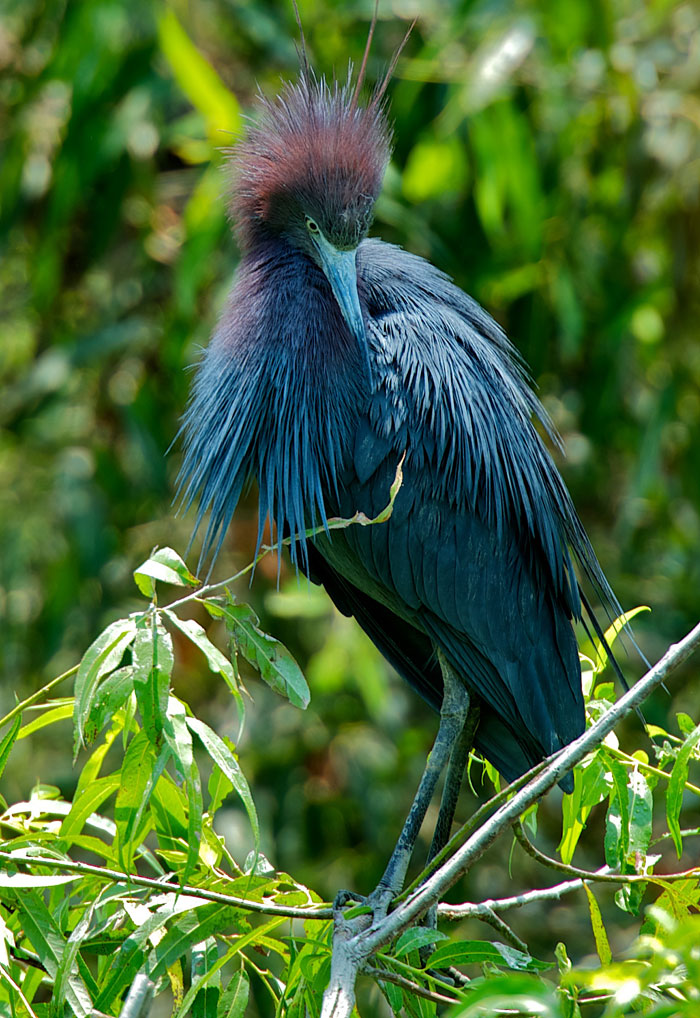
When a Little Blue Heron puffs up...

...he really puts on a show! Of all the herons, the Little Blue seems to be most dramatic in his displays. He goes from mild mannered (almost dull) to spectacular in a single breath!


...puffed up and in full breeding plumage, a Little Blue Heron creates a huge splash of color and drama...

...ominous...

...contemplative...


...our mild-mannered Little Blue Heron's alter ego can not be held in check!


...a guardian among birds...


...able to leap anything he wants to!


...until he finally slips back into his mild-mannered Clark Kent in feathers character.


Photographed on 6/8/2011 at the Ibis Pond Rookery on Pinckney Island (Hilton Head, SC).
Click here for all the 2011 Pinckney Island posts.

Wednesday, July 27, 2011

The three baby Cattle Egrets...and mama from behind

These are the same Cattle Egrets from the previous post. Mama left the nest for a few minutes to chase away a Night-crowned Heron, and when she returned, she faced the other direction, showing off her beautiful nuptial plumage.

A Cattle Egret nestling looks on as his mama jumps up to convince a Night-crowned Heron to move on to his own nest!


Monday, July 25, 2011

"Avian Architecture" and a Cattle Egret building a nest...

Let's jump all the way back to the first week of June when I was in Hilton Head, SC. Just before I had left for the trip, I had started reading "Avian Architecture; How Birds Design, Engineer, and Build" by Peter Goodfellow. Since I was headed to a heronry, I knew I'd be able to see lots of examples of nest building, and I did. I found platform nests, cup-shaped nests, hanging, woven and stitched nests, domed nests, holes and tunnels, and aquatic nests. If I had not been reading "Avian Architecture" at the time, I don't know if I would have been as intent on finding all the different types of nests. In years pasts at the heronry, I always admired and was amazed by the nests, and I had a cursory understanding of their structure, but it took reading "Avian Architecture" to really bring the engineering to life and deepen my appreciation of the building process. It's a great book to add to your birding library. I love it. Blue prints, photographs and lovely watercolors help you assimilate a lot of information quickly. It won't take long to help you understand another facet of bird life.

A Cattle Egret adds another stick to the nest. Cattle Egrets are colonial nesters and build platform nests near water, so it was no surprise to find them nesting in the heronry at Ibis Pond.

Male and female Cattle Egrets look similar and both parents participate in nest building, but often the male brings the sticks and the female places them; therefore, I'm deducing this is a female Cattle Egret.

...the nestlings seem to be saying something like, "Adding to the nest is all fine and good, but we're hungry. Feed us!"

...the perfect stick...in the perfect place.


Here are a few videos of the mama Cattle Egret arranging her nest. In the first video she's adding a new stick and in the second, she's trying to reposition an older twig that doesn't seem to want to budge. Also...in the first video you'll hear a conversation between me and Paul Krusling (the Cincinnati birder and expert herpetologist I had to travel 12 hours to meet! Click here for a previous post on Paul.)

Cattle Egret Building Nest from Kelly Riccetti on Vimeo.


Cattle Egret continues tidying her nest... from Kelly Riccetti on Vimeo.

Saturday, July 23, 2011

A Boston Harbor Herring Gull...and a Barking Crab...

A Boston Harbor Herring Gull from Kelly Riccetti on Vimeo.

We came to Boston for history, staying in the North End and walking the Freedom Trail, but Matty loves seafood, so when he remembered Adam Richman (from Man v. Food) had eaten at the Barking Crab in Boston, we had to make it a destination.

The Barking Crab off Boston Harbor at Fort Point Landing--it hugs the water and has lots of personality. We had such a good time there--the waitress was fun, the people around us were fun...everything about it was a party.

...Matty standing outside the Crab. He loves old buildings, dives, and seafood...plus, of course, Adam Richman ate there, so this place was perfect!

...the Barking Crab was easy to get to by water taxi (we used Rowe's Water Taxis to and from the airport and around the harbor...very easy). After eating, we walked back to our hotel sticking to the harbor walk. Along the way we stopped at the Blues Barge to listen to live music (so cool). After that we saw the Herring Gull on the old piers and sat down next to him for a video..it was a perfect evening!


The Barking Crab in Boston from Kelly Riccetti on Vimeo.

...Matty tasting some of the fare at the Barking Crab. (I took this video with my iPhone...it's a great little camera too!)

Thursday, July 21, 2011

A Boston Sparrow...and a Boston Freedom Trail Sampler

...on Sunday Matty and I planned a last-minute trip to Boston to walk the Freedom Trail. Rick had to work, but we really wanted to walk through history, so we went for it, and I'm so glad we did! Boston was amazing. We stayed in the North End and walked everywhere, burning up tons of calories so we could eat tons of incredible Italian food...

...of course, wherever we are, birds are part of it, and Matty and I loved all the Boston city birds. When we first arrived, we took a water taxi to our hotel, and as soon as we set out into the harbor cormorants flew by...up close and gorgeous. Lots of gulls and a few terns were along the docks...and among the city buildings and in the parks, sweet little English House Sparrows were everywhere. This little sparrow was just a few feet from me in the King's Chapel Burying Ground...

A Boston Sparrow from Kelly Riccetti on Vimeo.

We got home early this evening, so I thought I'd throw a Boston Freedom Trail "Sampler" up quickly. I didn't take my big camera with me, opting to travel light, so I used my little Panasonic Lumix and my iPhone. They both worked out well...

Listen, my children, and you shall hear
Of the midnight ride of Paul Revere,
On the eighteenth of April, in Seventy-five;
Hardly a man is now alive
Who remembers that famous day and year.
Longfellow

...Matty walks towards Quincy's Market...across from...

...Faneuil Hall...

...where that very famous grasshopper has been perched for a very long time...

...tombstone art...always a favorite of mine.

...and there's lots to go around in Boston. This design is a little different from the norm...

The Paul Revere memorial in the Granary burying Ground...

For making such a large mark on history, Revere's tombstone is remarkably modest.

"Don't fire until you see the whites of their eyes..."
Bunker Hill Monument (...located on Breed's Hill where the battle was fought on June 17, 1775.)

...more to come.