Friday, April 15, 2011

Dutchman's Breeches and a resident tiny spider...

This winter a good deal of invasive honeysuckle was removed along the Little Miami Trail near the Old Kings Powder Factory where I walk, opening up the forest floor and offering endless views of wildflowers I didn't even know were there. Couple that with new awareness of spring ephemerals and tiny mustards, and I can barely stay at home. Each day something new seems to be blooming. In three or four huge sweeps Dutchman's Breeches, Squirrel Corn, Trillium, Yellow Trout Lilies, Bloodroot, and much more cover the ground.

Dutchman's Breeches, Dicentra cucullaria, carpet the floor of the forest on both sides of the trail. They are fun-looking little flowers, definitely resembling old-fashioned pantaloons hung out on the line to dry! On this little sprig, a tiny spider has taken up residence.

...no spider in this view, but evidence of her visit exists in the tiny filaments attached to the stem.

I can't see you at all little spider...you're hidden so well!

...at first she just sends out a leg...

...but then I see her little spider face.
(I have no idea what kind of spider this is, or whether she is a male or female, but I bet someone out there does!)

You really have to love those cute pantaloons hanging out to dry...

Thursday, April 14, 2011

Red-breasted Merganser at Ding Darling...

...continued from the Captiva Island posts.
Matty and I watched a sweet female Red-breasted Merganser diving and preening at the Ding Darling NWR for a long time. She was very fastidious with her preening, and just as ambitious with her diving!

Now you see her...

...now you don't!
A female Red-breasted Merganser uses her powerful webbed feet to propel her into deeper waters to search out her prey, small fish. She hunts by sight, so it's no wonder we found her in such clear water...she logged a lot of underwater time!

...now you see her again (which means it's time to preen)!

Tuesday, April 12, 2011

More bird paintings...and a field of tulips for good measure!

I have been painting, but I've only been posting the paintings on the 100 Paintings Challenge site because I've been trying to get the little mustards and wildflowers from the Adams County field trip and the Florida birds from the Captiva trip posted (but, if you know me, I always have a bit of Short Attention Span Theater going on, so I thought I'd pop the paintings up tonight). The paintings in this batch are all impressionistic with the emphasis on color and feeling...


Painting 137. Avis Spei
(Oil Pastel, 9x12 Sennelier Oil Pastel Paper)

"Avis Spei" is packed with hope, love, and the promise of summer. The painting is based loosely on the newly arrived Blue Gray Gnatcatchers in our area. I really didn't know what to name it, so I asked Matty if he had any ideas. He thought we should come up with a new "scientific" name based in Latin, because finding this bird in a field guide might be a bit iffy! With all the color and energy surging through it, he thought "Avis Spei" would do the trick -- Bird of Hope! :-)


Painting 136. Spring on the Little Miami with the Blue Gray Gnatcatchers
(Oil Pastel, 10x10 Sennelier Oil Pastel Paper)

"Spring on the Little Miami" honors the Blue Gray Gnatcatchers that have just descended into our woods. When spring rains come, these little imps are never far behind. Last Saturday evening after the rainfall, Rick and I headed over to the Little Miami River to see if the Gnatcatchers had arrived. We weren't on the trail very long before we heard their constant chatter and spring song. I didn't bring my camera, so I had to create this little bird from memory. I painted her a little bluer than she really is...because I was so happy to see her, and I added in lots of summer green because I always think about them gleaning insects from the green leaves (sometimes the imagination is a little more fun--and dramatic--than the camera!) If this had been a male, I would have added a black "eyebrow" stripe.


Painting 135. A Captiva Blue in Green
(Oil Pastel, 9x12 Sennelier Oil Pastel Paper)

"A Captiva Blue in Green" is a Great Blue Heron from our recent trip to Captiva Island in Florida. I love all the Florida birds...and can't get enough of them! I also can't seem to get enough of the Sennelier Oil pastels. I've noticed that I seem to have a different style with each medium I use with impressionism winning out. However, I can feel a detailed and realistic watercolor brewing in my head...


Painting 134. The Rush of Spring
(Acrylic, 16x20 Stretched Canvas)

"The Rush of Spring" is a raucous representation of spring--a field of tulips blowing in the wind and bursting with color. The image is totally made up, based on an impression left in my brain from the early 70s when my family went to Holland, Michigan. I LOVED that trip...seeing the huge fields of tulips has always stayed with me. The big windmill was pretty cool too! :-) I don't know if my brother was as impressed as I was, though. Since he checks my blog every day, I'm sure he will let me know!

Sunday, April 10, 2011

A big gulp at Ding Darling...

...continued from the Captiva Island posts.
One of the best parts of our Captiva Island vacation was located on the island next door...the Ding Darling National Wildlife Reserve on Sanibel Island. Usually I went to Ding Darling by myself while Matty and Rick played tennis, but one day Matty came with me. We were both watching this Great Blue Heron when he suddenly harpooned a huge fish. From the initial grab to the final swallow took one minute and 24 seconds...that's a big gulp!


Matty and I assumed there was no way the Great Blue Heron was going to be able to swallow the fish down whole. We were amazed he was able to lift the huge thing out of the water!


...thinking...


...thinking...


...repositioning...


...yowsers...


...Holy Cow...


...no way...


...yes way!
I love this shot because it clearly shows a unique trait among herons and egrets. In addition to having a long and slender neck, they are different than other birds and animals because their esophagus and trachea cross over and are located behind the spinal column. You can see that in the photo because the outline of the fish is at the back of the neck. This trait allows herons and egrets to compress their necks like a snake...and then strike out with explosive force to harpoon fish with their sharp bills. The location of the trachea and esophagus behind the vertebrae also protects them if the heron hits something while striking.


p.s. Saturday evening Rick and I took a walk along the Little Miami after the rainstorm, and we were "flooded" with Blue Gray Gnatcatcher song. The cute little birds were everywhere. Just two days earlier, I hiked the trail looking and listening for them, but they were no where to be found. I love when the little imps move in. Spring is here...

Saturday, April 9, 2011

An osprey in a palm tree...

...continued from the Captiva Island posts.
...it just doesn't get any better than that!
(I still have lots of wildflower photos from Adams County, but since it's rainy, cooler and grey here again, and all the Captiva Island birds are still waiting to get out, I decided to jump back to beautiful, sunny Florida.)

The couples' favorite perch when not in the nest with the baby (one always stayed in the nest) was in this palm tree. It was located on the path to the pool.

...the two always maintained a constant chatter with each other.


...looking towards the nest.

...the view of the nest from under the palm tree.

If you read this earlier post, you know our porch looked out on an osprey nest where one little baby demanded a lot of attention. The mama and papa were almost always in communication with each other, and their constant calling back and forth was wonderful to hear. Often, one would sit in a palm tree about 300 yards away, surveying the land and making sure all was well.

Thursday, April 7, 2011

Golden-star, Erythronium rostratum, in Scioto County

...continued from the Adams and Scioto County wildflower posts.
Our next stop on the wildflower tour was the beautiful wooded hillside along Rocky Fork road in Scioto County. There, we were hunting out the very rare Golden-star, Erythronium rostratum...

Golden-star, Erythronium rostratum, makes a valiant attempt to open despite the overcast and cold conditions.

...raindrops bead up on a leaf of Erythronium rostratum.

...working harder! We had high hopes that the sun would push through and coax the blossom open.

...anthers carrying pollen.

...makes me think of a sleeping dog opening one eye to make sure all is well.
The sun didn't come out until later in the day, so we didn't get to see this incredibly rare wildflower fully open.

A remnant raindrop magnifies the dotted pattern on the Erythronium rostratum leaf.

To get an idea just how rare this plant is in Ohio, and to learn how to tell Erythronium rostratum apart from the much more common Yellow Trout Lily, Erythronium americanum, (plus read about the newly discovered population in the Edge of Appalachia Preserve), hop over to this post on The Natural Treasures of Ohio Blog. This afternoon I took a walk on the Little Miami Trail and found Erythronium americanum growing there! It definitely looks different...its flowerhead was drooping down and the petals were all reflexed (curving back) like the White Trout Lily in this earlier post.

P.S. I just visited Jim's blog, and he's posted on this beautiful flower too, so if you haven't already seen his post, make it your next click!

Wednesday, April 6, 2011

A cedar glade prairie...and a beautiful little mustard...

After meeting up at Adams Lake State Park, our mustard-hunting group car pooled to a small cedar glade prairie where a rare mustard was known to grow. This was all new to me. I had never searched for a tiny mustard, and I had never been to a cedar glade prairie, so I really didn't know what to expect. Jim (our expedition leader and author of Ohio Birds and Biodiversity) talked about the glade, explaining its unique habitat is a result of dolomitic limestone bedrock located just under the surface of the soil. The shallow soil, and in some locations exposed limestone, prevent large trees from growing, which creates the prairie habitat. "Cedar" in the name comes from the fact eastern red cedars (Juniperis virginiana) are located throughout the glade, growing in cracks in the bedrock. It didn't take Jim and the other experienced wildflower hunters long to find the first mustard, and soon we were all tiptoeing through the glade, searching out these tiny plants. I was amazed at how quickly I fell in love with these diminutive wonders...

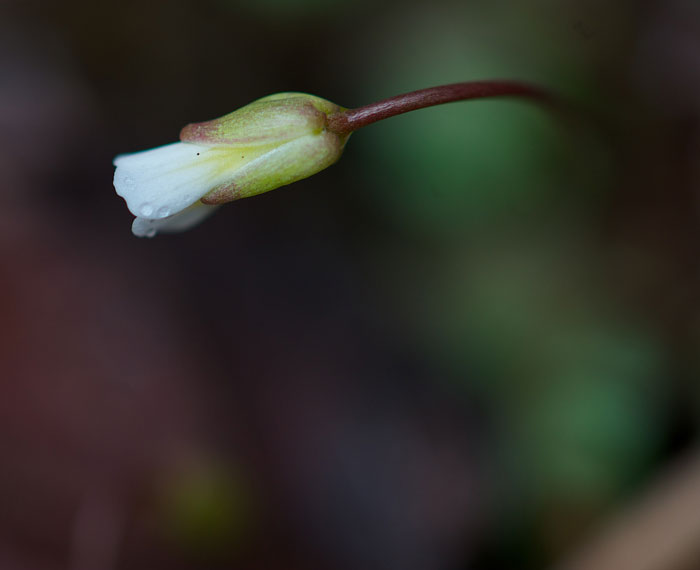
...a tiny blossom of Michaux's Gladecress, Leavenworthia uniflora, stands tightly furled against the chill of the overcast spring morning.

...raindrops from an earlier shower cling to its tender petals.

Until the sun's rays warm the flower causing the sap to flow more rapidly through the leaves, stems and blossoms, the petals will remain closed, protecting the pollen from being washed away by chill rain and nighttime dew formation.

I vaguely remembered how the sun's warmth coaxes blossoms open, but I wanted a refresher. I found an article called "The Sleep of Plants," by Arabella B. Buckley--Youth's Companion, in the magazine "Current Literature," Volume V, July - December, 1890, pg 470. I loved the poetic and beautiful language from that earlier time...and the way the author explained how a flower "wakes up." (Click here for the entire article.) Simplified, as the sun warms the flower, and the sap starts to flow more forcefully through the vessels in the petal, the skin on the inside of the petal, which has been curled up tightly through the night and therefore is still warm and pliable, starts to expand, slowly pushing the blossom open. The skin on the outside of the petal, which has been exposed to the cold all night, is still rigid and inflexible. The petals will continue to push open until the tension on the inside surface of the petal is equal to that on the outside surface of the petal.

...a tiny glimpse of the bright yellow center waiting to burst forth. The sun never did break through the clouds while we were in the cedar glade, so I didn't get to see this little beauty fully open. I guess I'll just have to try again next year!

The leaves of Leavenworthia uniflora look fairly large in this macro photo, but they aren't! They are just a little bigger than a quarter.

...a teeny, tiny orange and white leafhopper popped onto a small dead stalk next to the Leavenworthia uniflora. If I had not been on the ground studying the diminutive mustard, I never would have seen this beautiful little insect!

This is the third post in the Adams County Lilliputian Mustard Expedition. Click here for the entire series.