Thursday, April 18, 2013

Red-shouldered Hawks on nest along the Little Miami River...

I took the afternoon off work today and headed to the Little Miami River. It's been so long since I've spent an afternoon looking for birds, and I loved it. The spring migrants are moving in, and I could hear their new birdsong filling the river corridor. I saw lots and lots of Blue-gray Gnatcatchers, and heard and saw my first Northern Parula and Indigo Bunting of the season, but seeing a male and female Red-shouldered Hawk (Buteo lineatus) on their nest was the highlight....

Red-shouldered Hawk (Buteo lineatus)
A male Red-shouldered Hawk (Buteo lineatus) on a nest. He flew in to relieve the larger female (hidden from view).
This nest is located on the Little Miami River and bike trail about a half mile from the abandoned Peter's Cartridge factory. I saw it last year, but construction was only half-hearted and the hawks never occupied it, but earlier this year, when snow was still on the trail, I noticed the nest was slowly being beefed up, and today I saw why...mama and papa have settled in!

...eventually the larger female Red-shouldered Hawk starts to pop up. It's time for her to fly out.

...there she is. You can see how much larger she is.

...stretching her wings.

...right after this shot, she flew out of the nest to an adjacent tree. Then she took off. I can't wait to see the babies after the eggs hatch. Let's hope the couple is successful. 

Tuesday, April 16, 2013

Sweet Swamp Sparrow at Spring Valley Nature Area...

Before we went to the Little Miami trail to look for the eagle's nest (click here for that post), Rick and I spent some time on the boardwalk at Spring Valley hoping to catch a glimpse of the Virginia Rails. We heard two rails calling close to the observation deck, but they stayed hidden in the cattails. That was okay, though, because while we waited patiently for the rails to peek out, a very pretty Swamp Sparrow caught our eye as he waded in and out of the shallow water around the observation deck...  

A Swamp Sparrow (Melospiza georgiana)
A male Swamp Sparrow (Melospiza georgiana) wading into the water looking for something to eat. 

A Swamp Sparrow (Melospiza georgiana)
True to their names, Swamp Sparrows really like water. This fellow acted more like a shorebird wading through the water than a sparrow.  

A Swamp Sparrow (Melospiza georgiana)
A Swamp Sparrow from behind is pretty. I like his droopy wings and rusty colors.

A Swamp Sparrow sitting on dead cattail stalks at Spring Valley Nature Area.
A Swamp Sparrow perches on dead cattail stalks. He was singing his lovely song from this perch. He's probably migrating through, though, not setting up a territory. Swamp Sparrows breed in Ohio, but much further north. 
It was really nice to just sit on the observation deck in the warm sun and listen to the Red-winged Blackbirds singing all through the marsh. Beautiful Blue-winged Teal flew over regularly, and an Osprey took to the wing flying by low. Painted Turtles were everywhere basking on logs, and we could hear frogs and toads from the marsh edges...

Painted Turtles (Chrysemys picta) basking in the sun at Spring Valley Nature Area.
Painted Turtles (Chrysemys picta) on a submerged log soak up a bit of sun.
...it was hard to leave the boardwalk. I loved lazing the time away in the warm sun just watching and listening to the birds. If that log were bigger I would have crawled out there and joined the turtles!

Sunday, April 14, 2013

An American Bald Eagle on a nest along the Little Miami River...

Last October, Matty and I spent some time up at the Spring Valley Wildlife Area photographing what we thought might be an eagle's nest (click here for that post). Today Rick and I drove up to see if it was...and it was!

An American Bald Eagle sits on a nest along the Little Miami River at the Spring Valley Wildlife Area
Okay...squint, step back and look carefully. Yes, it's there...a white head and a dark body. Finally, I've seen an American Bald Eagle on the Little Miami River. The quality of the photo is poor, but I was over 500 yards away shooting from the bike trail, and then I cropped the image to an inch of its life to try to make out the eagle. 

A huge eagle's nest fills a sycamore along the Little Miami River near the Spring Valley Wildlife Area. This is the view from the bike trail...
View of the eagle's nest from the bike trail. The nest is bigger now than it was this October, and there's no mistaking an eagle is in residence. When you look through binocs or the spotting scope, you can clearly see the bird, but through a 400mm lens, the eagle is nothing more than a bump on a blob!

This huge sycamore hugs the Little Miami River. Canoeists floating down the river are in for a treat if they look up! From the bike trail, it's a different story. However, just hang out at Spring Valley for a while, and you'll see the adults flying overhead or even grabbing a fish from the water. Rick and I spoke with a fisherman at the lake, and he said he's seen an eagle several times swooping down to catch a fish. What a sight!

Thursday, April 11, 2013

Lesser Yellowlegs foraging in a flooded field...

The sky was gray as the late afternoon sun faded away behind heavy clouds, but not even the approaching gloom could dim the spectacular yellow color of the legs on a Lesser Yellowlegs as he picked through the shallow waters of a flooded field at Voice of America (VOA) MetroPark...

Lesser Yellowlegs (Tringa flavipes)
A Lesser Yellowlegs (Tringa flavipes) forages in the shallow waters of a flooded field at VOA MetroPark in West Chester, Ohio.

Lesser Yellowlegs (Tringa flavipes)
A Lesser Yellowlegs has his eye on something...
Is that a Lesser Yellowlegs or Greater Yellowlegs? I'm pretty sure this guy is a Lesser. He didn't seem tall enough to be a Greater. The best way to tell Lesser and Greater Yellowlegs apart is to look at their height, bulk, and the length of their bill. Lessers are about 10 inches tall and have dark bills about the same size as their heads. Greaters are about 14 or 15 inches tall and have slightly upturned bills a little longer their heads. Greaters are more bulky as well.  

Lesser Yellowlegs (Tringa flavipes)
The water in the flooded fields wasn't that deep, but it was perfect for Lesser Yellowlegs. Earlier I saw this fellow nab a small crawdad (aka crawfish or crayfish) and there were empty crawdad shells scattered all over the fields where the water had receded. Maybe he has his eye on another?
Where did all of those crawfish shells come from? To grow larger, a crawfish must shed its shell and grow a new one. It may do this ten to fifteen times in its lifetime. After it molts, it is very soft, so it pumps itself up with water to gain girth and make lots of room for the new shell to form. Crawfish are mature at two years and can live up to seven years (click here for more information on crawfish).

Lesser Yellowlegs (Tringa flavipes)
The classic profile of this beautiful bird...

Lesser Yellowlegs (Tringa flavipes)
 A Lesser Yellowlegs foraging in a vernal pool in late afternoon light.


A Lesser Yellowlegs gets ready to nab dinner while "fishing" in a vernal pool at VOA MetroPark.
...watch out crawdad!

Wednesday, April 3, 2013

Spring's beauties...

It was cool this afternoon at 46 degrees, but it was sunny, and you could feel the shift of winter to spring in the warmth of its rays, so I headed over to the Little Miami River to see if any wildflowers were blooming. I knew I wouldn't be able to walk very long, but I wanted to see some of spring's beauties...

Spring Beauty (Claytonia virginica) - the first wildflower of spring.
Spring Beauty (Claytonia virginica)

Spring Beauty (Claytonia virginica)
Spring Beauties are one of the first ephemerals to bloom along the Little Miami River.

...the five stamens and long thin leaves of a Spring Beauty make it easy to identify this spring ephemeral.
When identifying Spring Beauties, look for five stamens with pink anthers and long thin leaves. The stem is often reddish and the petals have beautiful pink striations.  


Golden-crowned Kinglet...another one of spring's beauties (...although we have Golden-crowned Kinglets in our woods all winter, they look especially sweet in spring).

Tuesday, February 26, 2013

Wood Storks and their unique way of feeding...

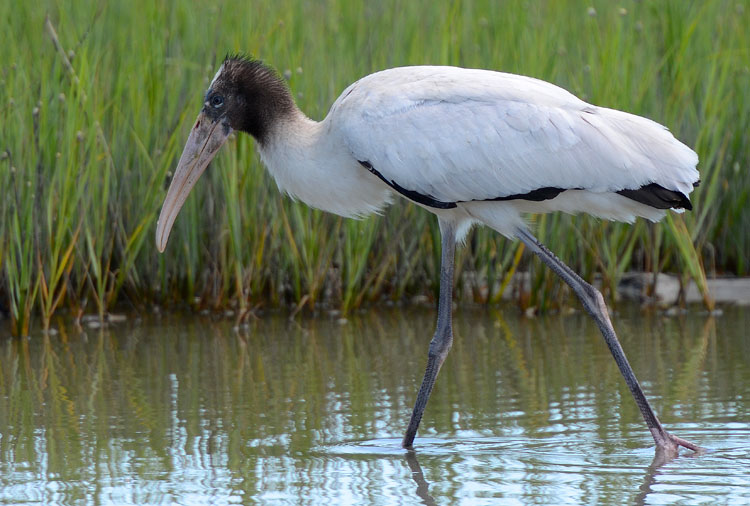
I could not believe my luck when I saw this small group of Wood Storks (Mycteria americana). They were feeding in the shallows along the driveway to the Pinckney Island NWR. It was my last day of vacation and I was leaving the park. I was glum and morose, and just like a kid dragging her feet, I was driving slowly with the windows open, watching the water and the grasses, trying to wring out every last bit of the island that I could. Leaving Pinckney is never fun, but suddenly, zing! yes!! happiness!!! -- Wood Storks were feeding about 50 feet away in the shallows...

Juvenile Wood Stork at Pinckney Island NWR, South Carolina
A juvenile Wood Stork feeding in the shallows at Pinckney Island NWR in South Carolina.

I pulled the car over and watched the small flock through the binocs. The birds were feeding, and I could see them stirring the water with their feet. They had their bills open in the water, waiting for a fish or crab to make contact. After a while, I got out of the car, crossed over and sat down behind the grasses. I remained still and quiet, and they went about their business of fishing and eating...

...a juvenile Wood Stork fishes with his bill open, waiting for a fish or crab to make contact.

Woods Storks have a unique way of catching their prey. They like to forage in shallow water with large concentrations of fish or crabs where they hold their bills open in the water. When a fish or crab makes contact with the bill, it triggers a snap-shut reflex, and the Wood Stork nabs its dinner without ever having to see into the murky water. Because Wood Storks are tactile feeders and do not have to see their prey to catch it, their method of feeding is called "grope-feeding" or "tacto-location." Click here for a detailed explanation of this feeding method and other information on Wood Storks.

In the following video, you can see the Wood Stork stirring the water with its foot, then scooping up a little crab. At the end of the video, I put some of the action in slow motion to better see the Wood Stork eating a little crab...


A Wood Stork uses "foot stirring" to drum up some lunch. 

The Wood Stork is endangered in the United States, so I was especially happy to have been in the right place at the right time to see this small flock of Wood Storks...even if it was my last day of vacation.

Wood Storks are doing well in Georgia and South Carolina, and the government is thinking about changing their status from endangered to threatened. Click here for an NPR article and broadcast of the story.

Wood Storks are large birds. This guy was over three feet tall. I loved watching him move slowly through the water.

An adult and a juvenile Wood Stork walk single file. The adult is on the left. Check out that bald, scaly, woody looking head. On the right is the juvenile Wood Stork, still fresh and new and covered in feathers. 

In part two of this series I'll focus on the adult Wood Stork's face, so you can see how different a juvenile and an adult look. I took these photos on June 19, 2012.

Sunday, February 3, 2013

A grumpy Carolina Wren demands mealworms...

While I was working in the kitchen earlier today, the strident scolding and squawking of a Carolina Wren caused me to look out back. "Oooops...sorry fella," I said through the glass. He was nonplussed with my response and scolded me some more, hopping from the peanut feeder, to the ground, to the table and back, just like a little kid stamping his feet and screaming for candy. You don't have to speak wren to know what he was saying...
"Gimme my mealworms, now!" 

A Carolina Wren hangs on a suet feeder. Usually he's happy with the suet treat, but when it snows, he demands mealworms.

Grumpy little thing....

...grumpier little thing!

A pouting Carolina Wren cannot be ignored, so I did what any well-trained bird lover would do. 
I got on my coat and boots and went out in the snow to refill the feeder!

Uhhhh ohhhh.....guess who else likes mealworms?
A Starling was the first bird to return to the deck after I refilled the mealworm feeder.

The Starling quickly snapped up the mealworms on the ground. 

...but no worries for the Carolina Wren. He knows I put mealworms in this tiny ceramic bird house. It's too small for a Starling to fit in, but a Carolina Wren can easily poke his head in and nab a mealworm.

...yes C.W., next time I'll do a better job keeping the mealworms replenished!

Click here for other posts over the years of our mealworm-eating Carolina Wrens.