Showing posts with label Magee Marsh. Show all posts

Tuesday, October 6, 2015

The Gray Catbird on the boardwalk...

...this is probably one of the most recognized (and ignored) Gray Catbirds on the planet. I saw him in May when I was at Magee Marsh (near Toledo, Ohio) at the Biggest Week in American Birding warbler festival. Every time I was there, so was he...literally on the boardwalk, walking around trying to get everyone's attention. When you're a Gray Catbird surrounded by thousands of brightly colored rare warblers, you have to work a little harder to get any respect...

I saw this sweet catbird during the Biggest Week in American Birding warbler festival.
A beautiful Gray Catbird at Magee Marsh

Hey! Look at me...I'm a neotropical migrant too (just a little larger and grayer). 

This Catbird was not afraid of anyone. He would walk the planks while people looked on and walked past him. Apparently Gray Catbirds are forced to take drastic measures to compete with the glittery, colorful, tiny, fleeting warblers...

When he wasn't on the boardwalk, he dropped down beside it to forage on the ground and in shrubs for insects. He really is quite beautiful, and when he's not mewing, he has a lovely and varied song (mimicking other birds as well). 

Catbirds are great subjects to study to learn wing feathers. Since the birds are large, the feathers are easy to see. On the top of the "stack" are the three tertials, followed by the secondaries, then the primaries (the longest flight feathers) on bottom. 

The spring songbird in the winter gray flannel suit... 

Is it neophilia, or is it gray flannel?
If I heard, "Oh, it's just a catbird," once, I heard it a million times. These poor birds with their sweet mews and songs got no respect along the boardwalk. It's easy to understand, though. In the grips of WARBLERMANIA, the more common songbirds often fall by the wayside. Neophilia is the love of or enthusiasm for what is new or novel, and humans often fall prey to its lure. Many of the spring warblers are fleeting and rare and are definitely novel in our parts. Some of the visitors stay, but others are just stopping off on their long flight north adding to their mystique, but our sweet berry-loving catbirds are brave enough to live among us, becoming commonplace in the process. In the wild, catbirds like swampy, boggy, and soggy areas. You can always find them streamside along the Little Miami River, but they are neotropical migrants that can adapt, and they have taken to suburban and urban backyards packed with berries. We have resident catbirds in our backyard all spring and summer. They come readily to the mulberries and then stick around for the pokeweed berries, so maybe that's why throngs of people move quickly past them to look for the cute and colorful rare warblers...

...or maybe it's just the gray flannel! 

Friday, June 19, 2015

There's magic in the swamp...

This Northern Parula charmed a group of adoring fans along the boardwalk at Magee Marsh during the 2015 Biggest Week in American Birding. I was there with two of my birdy friends Kim Smith (Nature is my Therapy) and Janet Kissick Hug (Nature's Feather Music). We were actually looking for an elusive Blackpoll Warbler singing low in a swampy tangle when this spunky little fella flew in and perched right next to us...

A Northern Parula along the boardwalk at Magee Marsh
I think we were all dumb-founded for a moment as the brave little bird studied us. I've never been so close to a Northern Parula. They usually laugh at me from the treetops where they're safely out of camera range, but this birdy bird was different. He seemed to be curious and sat watching us photograph him...

A Northern Parula studies a flock of adoring fans...

...this Northern Parula took his time looking back and forth at a steadily growing group of people marveling at his beautiful colors and proximity.  What can you say? It's the Biggest Week and there's magic in the swamp.


...eventually he tired of us, turned the other way, and flew off to nab an insect.

The Biggest Week = A Giant Love-fest of Birdy Birds and Birdy People
...which is why I love going to the Biggest Week. I see incredible close-up views of birds I don't see very often, and I get to do it surrounded by people who love birds as much as I do. There is something special about waking up and heading out to the boardwalk where you are among hundreds of people who all love birds. It's great. Wherever you turn, you meet a person willing to help you ID a bird, or point one out...or a person just as excited as you to talk about their finds and what they saw further up or down the boardwalk (in other words, you get no blank looks or glassy-eyed stares when you start talking about birds, their nests, migration, ________, etc.). If you're going, let me know. I'll find you on the boardwalk!

Mark your calendars...the dates for the 2016 Biggest Week are set: 


http://www.biggestweekinamericanbirding.com

Monday, May 11, 2015

Blackpoll Warbler at Magee Marsh...

I made it to Maumee Bay this afternoon, and it's lovely. Right now I'm sitting on the couch in my little cottage listening to warblers...warblers…and warblers, although, as each minute passes, the bird song diminishes. It's almost 9:00 p.m., and the birds are all starting to tuck themselves in for the night. A cool breeze is blowing through the cottage thanks to a cold front that moved through earlier, and tomorrow is going to be a wonderful day. This evening I stopped in the lodge and met up with a lot of my birdy friends…and made a few new friends. BIRDY people are the best! I also won a "Squirrel Buster" bird feeder! Me…won!  All courtesy of The Biggest Week in American Birding!

A Blackpoll Warbler looks for insects along the boardwalk at Magee Marsh. 
Warblermania and Spring Migration
When you visit the boardwalk at Magee Marsh (near Toledo, OH) in May, you get up close and personal with the amazing phenomena of spring migration. The trees along the boardwalk literally drip with neotropical migrants as they rest and fuel up for the last leg of their journey across Lake Erie to their nesting grounds up north.

In addition to seeing all the amazing birds--often at eye level--you get to meet other enthusiasts who love birds as much as you do. The atmosphere along the boardwalk is that of a festival where birders of all levels help each other spot and identify these amazing birds. If you're a beginner, don't worry, there are lots of experienced birders there happy to help you learn about the birds.

He with the yellow feet and legs!
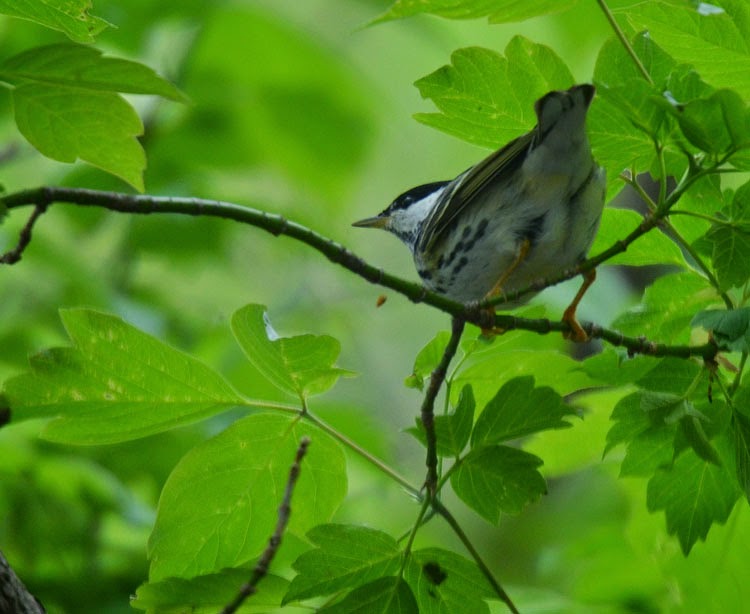
Blackpoll Warblers resemble Black and White Warblers, but when you look closely, you can see their markings are different. One difference is they have a black cap like a chickadee, while a Black and White Warbler has a stripe, but the easiest way to tell them apart is look at their legs and feet. A Blackpoll Warbler's extremities are noticeably yellow!


I will be blogging about the Biggest Week over the next few weeks. The birds, the people, the events...everything about the Biggest Week is amazing!

I'm looking forward to teaching the field sketching class tomorrow. It starts bright and early. I'll let you know how it goes! 

Wednesday, May 6, 2015

Can you say...anticipation?

Getting ready for the Biggest Week in American Birding!
In only a few days I'll head up to Toledo for the Biggest Week in American Birding where slews of migrating warblers will be flitting, darting, singing, foraging, perching, and dripping from the branches along the Magee Marsh boardwalk...

American Redstart at Magee Marsh 

American Redstart from behind!

...fiery orange among the branches.
American Redstarts stand out because of the strong contrast of black and orange in their feathers.

An American Redstart almost matches the orange fungi growing on the branch. 


I will be blogging about the Biggest Week over the next few weeks. The birds, the people, the events...everything about the Biggest Week is amazing!

Tuesday, July 29, 2014

Female Baltimore Oriole

I saw this Baltimore Oriole on May 14, 2014 along the boardwalk at Magee Marsh. A male Baltimore Oriole was much higher in the canopy of the tree flaunting his brilliant orange feathers, but this little female, understated in faded orange, was just as sweet, and she came in closer…

Female Baltimore Oriole, Magee Marsh, Toledo, OH (5-14-2014).

A female Baltimore Oriole studies a caterpillar before gobbling it up. Orioles also eat berries and even drink nectar from fruit blossoms.

I think it's hard to tell juvenile and female Baltimore Oriole's apart. Since this was early May, and most Baltimore Orioles don't return to Lake Erie until the first week of May, I assumed this was a female. Nest building starts soon after they arrive, and most babies fledge in late June and early July. 

Females build beautiful hanging nests. If you're in Cincinnati, you can often find a nest at Lake Isabella. I've seen nests there, and in the autumn, when the leaves fall from the trees, you can find the remnants of the summer's nesting activities! Click here for a photo of an oriole's nest.


This post is for Aunt Diane and Curg, whose spark bird was a male Baltimore Oriole they saw at Armleder Park (aka Armendinger Park) in Cincinnati, OH.

p.s. I'm enjoying our cooler weather. It was 49 degrees this morning, and I just had to go in and get a fleece-lined flannel shirt so I could continue sitting outside while I write this post.

Tuesday, July 1, 2014

Great Crested Flycatcher along the boardwalk...

With a sunshine-yellow belly and a loud, cheerful call, the Great Crested Flycatcher represents summer well. I don't get to see them often, though, because they like to hang out high in the canopy, so I was happy when one came into view along the boardwalk at Magee Marsh…

The famous lemon yellow belly of a Great Crested Flycatcher is always a welcome sight on a summer day.

Great Crested Flycatchers don't have much of a crest when they are at rest!

The little "whiskers" around the base of the bill are called "rictal bristles." They have a sensory function to help flycatchers snatch insects from the air.


...there's the start of the crest!
...and it's back down.
...and there we have it (not as "great" as a cardinal's crest, but pretty none-the-less). 

About rictal bristles...
Rictal bristles are modified contour feathers (the outer feathers you can see). Contour feathers have a central rachis (also called a shaft) from which the vanes (the feathery part) attach. A vane is made of individual barbs (filaments). A rictal bristle is a feather without the barbs…just the rachis.

Flycatchers have rictal bristles around their bills to help them sense flying insects, but rictal bristles can also be protective by helping to keep insects out of a bird's eyes, or in the case of woodpeckers, by helping to keep wood chips out of their eyes. If you want to learn more about feather structure, click here for info on Cornell's "All About Birds" site.

I saw this bird at the Biggest Week in American birding on the Magee Marsh boardwalk back in May.

Friday, May 23, 2014

The boardwalk eagles at Magee Marsh...

I had heard there was an American Bald Eagle's nest along the boardwalk at Magee Marsh, but I didn't know where it was, and with all the excitement of nonstop warblers flitting all around, I forgot about it until I saw an adult eagle fly overhead with a fish in its talons...exciting! I started walking in the direction the eagle had flown and soon heard someone say, "the baby has popped up!" I followed their gaze and was amazed at how close the nest was to the boardwalk...

American Bald Eagle and eaglet at Magee Marsh (view from the parking lot).

Adult American Bald Eagle preening.

The view of the eagle's nest from the boardwalk. I was told this was the second year for the "boardwalk" eagles. This shot lets you see how large the aerie already has become. 

A severed gull's wing hanging in a tree was evidence of the nearby eagle's nest. The gull wing became a landmark of sorts, and I heard once or twice, "a Cape May Warbler is at the gull's wing," or  "possible golden-winged warbler at the gull's wing."

I photographed the eagle and eaglet during The Biggest Week in American Birding.
I'll get busy with warbler posts soon!

Wednesday, May 14, 2014

Canada Warbler at Magee Marsh

I am having a lot of fun at the Biggest Week in American Birding, and I've seen oodles of beautiful warblers. Highest counts so far for me have been Magnolia Warblers, American Redstarts, Chestnut-sided Warblers, Bay-breasted Warblers, Wilson's Warblers, Blackpoll Warblers, Black-throated Warblers, and Canada Warblers (basically, they are everywhere). Here are a few shots of a female Canada Warbler...

…that big, bespectacled eye is gorgeous!


I would write more, but I'm exhausted...

The first field sketching class on Monday was a blast! What a wonderful experience. We all had fun, and everyone created fantastic sketches. The second class is tomorrow. Fingers crossed the rain holds off!

Wednesday, April 2, 2014

Yellow-rumped Warbler in the rain...

I photographed this Yellow-rumped Warbler in May of 2012 at Magee Marsh during the Biggest Week in American Birding. It was spitting rain that day, but the overcast skies and raindrops made the woods look greener and more lush, and the diffused light cast a beautiful softness over the marsh I'm glad I didn't miss. This little Yellow-rumped Warbler was not close, but he was busy and fun to watch as he looked for insects among the raindrops. He wasn't attracting much attention from admirers along the boardwalk. In the birding world, he's not one of the "heavy hitters," but I liked him just fine. His colors were gorgeous in the soft light, and his song was cheerful. I watched him as he worked his way methodically through a tree looking for food and brightening my day.  (I can't wait to head up to Magee this year for a whole week of warblers!!)

Yellow-rumped Warbler along the boardwalk at Magee Marsh.


See you at the Biggest Week!

The Biggest Week in American Birding warbler festival is May 6 - 15. 
Click here for information and registration.