Showing posts with label Starling. Show all posts

Monday, January 24, 2011

Beauteous Buteo

I walked into the kitchen Saturday to find a new species of hawk sitting in our half-dead weeping willow tree, Buteo jamaicensis--the Red-tailed Hawk! Compared to the Cooper's or even Red-shouldered Hawks that often perch there, this bird was a monster.

The beautiful rusty red tail of the Red-tailed Hawk was visible from the kitchen. He sat about eye level from me on the most "popular" hawk perch in the tree.

This is the view from our kitchen door. When I walked into the kitchen, I gasped and ran for the camera, thinking "Oh my gosh...that hawk is big!" When Rick came in a few minutes later, he found me standing on the back of the living room chair photographing him through the window and shouted, "Holy Cow! There's a dog in the tree!" (I laughed so hard I almost fell off the chair. Rick is always funny...)

The dog in the tree surveys his territory. We're used to Cooper's Hawks perching here and are familiar with their size. I didn't realize how much larger Red-tailed Hawks were.

Mild irritation seems to be showing on our Red-tailed Hawk's face. He's probably thinking "...enough with the photos, Chicky. Move along..."

"I SAID...enough with the photos...move along!"
"Okay, okay! I'm putting the camera down and am stepping away from the window..."

I wouldn't look so tough if I were you, Mr. Starling. Look who's sitting behind you just above your left shoulder...

Monday, January 17, 2011

Carolina Wren - 1, Starlings - 0

In the winter, our little Carolina Wren loves to eat freeze-dried mealworms. She will pass up everything else just to get to those crunchy little treats. Unfortunately, since the ground is now frozen solid and covered in snow, our massive starling flocks (from the local night-time roost) have started showing up at the feeders. While the ground was soft, they were content to dig grubs and other invertebrates out of the earth and pass our feeders by, but now that the ground is frozen solid, the crunchy, protein-rich dried mealworms must be the next best thing to live grubs. Mealworms are the larval (or grub) stage of a beetle, so it only makes sense. When a daytime flock swoops in, the mealworms can disappear in minutes, and then our sweet little Carolina Wren is not happy...

"I'm not happy. Where are my well-deserved crunchy freeze-dried mealworms?"

"I've looked left...and I've looked right...but nary an amber-colored crunchy is to be seen!"

"...look harder little wren! I hid them to keep them safe for you..."

"...what's in here?"

"Mealworms! Hundreds of them, I tell you!"


"Now that's more like it!"

So far, the starlings have left the wicker birdhouse alone, and only the Carolina Wren has been brave enough to peer in and find what she was looking for. The birdhouse is only about 4 feet from the kitchen door, so that might be discouraging some of the birds. Our Carolina Wren, however, is never afraid! I'll let you know if this system continues to work...


Thursday, January 7, 2010

What a face…what a face…(or beauty "in" the beast)

Our winter starlings have started visiting our feeders. (Oh, boy...right?) Actually, it's quite exciting when a flock descends on the yard. Hundreds and hundreds of birds swirl about squawking, scolding, and fighting...tree branches drip with the little feathered beasts, and I can hear them tapping across the gutters and on the roof. They bring in a lot of energy. Unfortunately, they eat up a lot of sunflower seeds, and they wreak havoc on the less rowdy birds that usually hang out. We have starlings year round, but they only become a nuisance during the winter when the ground is frozen. During the spring, summer and fall they keep to the ground, using their sharp bills to dig in the yard and root out grubs. They only get a little "beastly" during the winter...

...a starling looks a bit beastly in this head-on close-up shot!
I'm back, so you better get used to me!

When you step back from the “ucky stuff” they do, European Starlings are striking. Up close you can see their beauty, and they actually do a lot of good on the insect front. Invertebrates are their primary food source, and when bugs are available, European Starlings really do prefer Japanese Beetles to sunflower seeds...
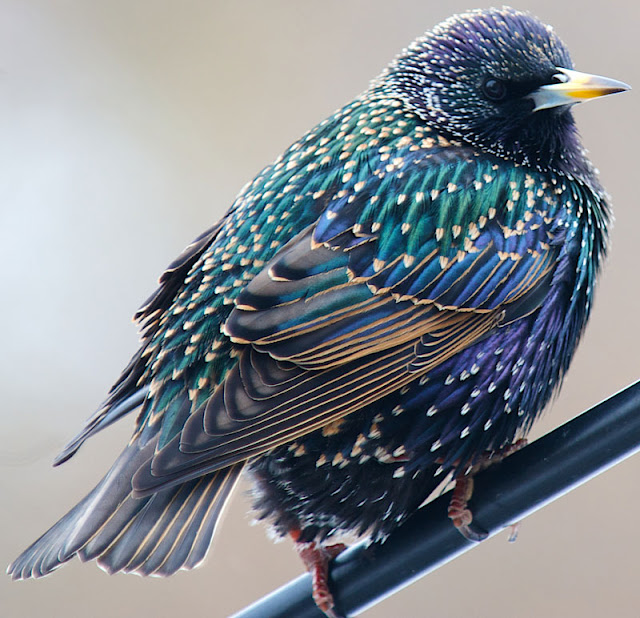
Close-up of the beautiful colors in a starling's feathers
Don't hate me because I'm beautiful...
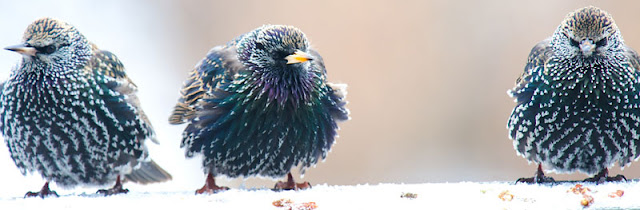
Three starlings sit together in the snow...not happy looking at all!
Grumpy, Grumpier...and Grumpiest
There are no Japanese Beetles in winter, and the June Bug grubs have burrowed beneath the frost line, so what's a starling to do? Be grumpy...and eat all of the sunflower seeds!


When the sun highlights their iridescent colors, they really are eye catching, but unless you look closely, you might not see it. Additionally, in the winter, their feathers are fresh and new, which adds a beautiful speckled pattern. By summer the speckling has worn off... 
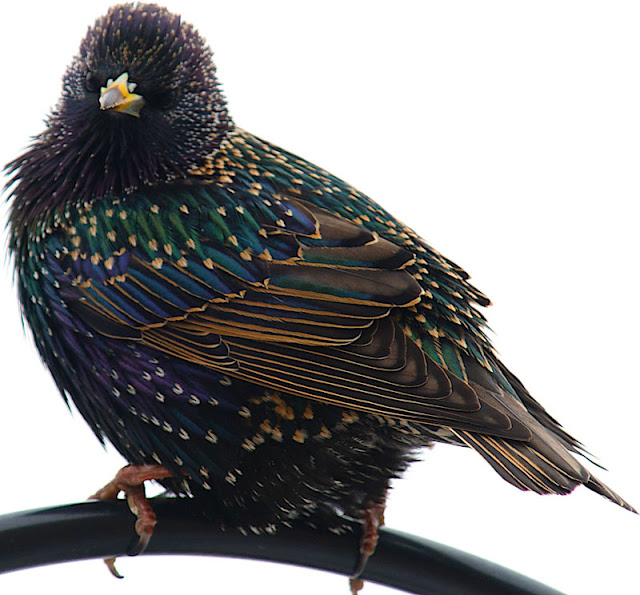
Close-up of the beautiful colors in a starling's feathers

Close-up of the beautiful colors in a starling's feathers

Close-up of the beautiful colors in a starling's feathers

...another bit of beauty starlings add to the world is their incredible winged ballet. A huge night-time starling roost is about a mile from our house, so in the early evenings of winter, we get to witness this spectacle…swirls and turns, a giant black cloud that moves at incredible angles quickly and without pattern...it makes me stop and stare every time I see it. Click here for a video from England that shows an example of this incredible sight. Click here for a post titled "How do Starling Flocks Create Those Mesmerizing Murmurations?" on Cornell's Round Robin blog by Andrea Alfano detailing these murmurations.

...starlings sitting in a tree.
...so while the ground remains frozen and covered with snow, we will probably always be a daytime roost for one of the flocks of starlings from our neighborhood night-time roost. 


I always try to remember that with the bad comes the good. We don't use pesticides on our lawn, so in the summer, starlings go to work for us. They are great at aerating the soil by digging up White Grubs (the larval stage of "June Bugs"), Sod Webworms, and other juicy invertebrates, which helps keep our lawn healthy.  The US Department of Agriculture's Farmer's Bulletin (1928) No1571 reports, "The starling is one of the most effective bird enemies of terrestrial insect pests in this country. More than half (57 percent) of the annual food of the adult starling consists of animal matter, including insects, millipedes, spiders, mollusks, a few crustaceans, and bits of suet and carrion." For more on the diet of the European Starling, click here. To learn more about night-time roosts and starling behavior, click here.

Happy Birding!
     Kelly

Tuesday, January 13, 2009

A Winter Starling Roost is Near our Neighborhood

I pulled into the driveway at home this evening to quite an impressive sight. A huge, ABSOLUTELY HUGE flock of starlings was swarming around the neighborhood in great clouds. This happens every now and then because our neighborhood is about a mile from a massive winter starling roost. In the evening, the birds all gather in the huge trees just off the field between Rt. 741 and Courseview. The noise is incredible and the sight is magnificent (whether you like Starlings or not, the sheer energy of all those birds is extraordinary). About two weeks ago, as Matty and I pulled into our driveway, the center of a massive flock seemed to move around us. Waves and waves of dark feathers and bird bodies swooped back and forth in constant motion, alighting for a second in trees or bushes or roofs and then bursting back up. We just sat there and watched them in awe. It lasted about 2 or 3 minutes before the swarm started moving down the street. It’s a great memory neither of us will forget.

A small part of the flock used my
neighbor’s roof as a temporary roost.

Why don’t they flock like this in the spring or summer? Starlings still flock then, but their numbers are lower. The smallest flocks are in the spring during the breeding season, and the largest in the winter when the flock takes in migrants from the north. Here is a helpful article on roosting and starling behavior.