
 |
| A Barred Owl perched in a tree along the Little Miami River. What a surprise to look up and see this fine face looking back at me! |
Showing posts with label Barred Owl. Show all posts
Showing posts with label Barred Owl. Show all posts
Wednesday, May 10, 2017
Barred Owl along the Little Miami River
It's been so long since I've been able to get out in the woods and look for sweet, sweet, little birdies, so when the sun came out and the temp climbed up, I grabbed my camera and headed for the river. I saw Black-throated Blues, Blue-gray Gnatcatchers, Wood Thrushes, Yellow-rumped Warblers, Scarlett Tanagers, Red-eyed Vireos, Chestnut-sided Warblers, woodpeckers, and all the other usual suspects...and then I saw this fellow perched high in the branches staring at me......sweet!


Sunday, October 23, 2011
The soulful eyes of a Barred Owl...
...this morning Matty and I had the rare opportunity of photographing a few of the world's most beautiful and interesting birds of prey. Being able to stand within arm's reach of these amazing predators and see the detail in their ever-vigilant eyes, or the pattern and flow of their camouflaging plumage, or the curve and strength in their efficient talons stirs emotion—especially when you know the only reason you can stand so close to them is because they have been injured (usually do to human interaction) and can no longer fly free. My friend, Rick Hartigan of Nature Trek Photo Safaris, who is also the organizer of the Ohio Valley Camera Club, invited us to a special meetup he put together with Raptor, Inc. to photograph and study these gorgeous raptors...


With large and dark eyes, a Barred Owl's soulful gaze catches our hearts...

...and even though many say anthropomorphizing is egotistic and fantastical (a product of a human's attempt to see the world through his own thoughts and feelings), would any other word work here?

...because even if this Barred Owl is not "soulful" (we have no idea what her thoughts are), we react with a soulful intensity when we look into her eyes, so what does it matter?

She has the ability to produce great, deep and wise emotions within us, and for that I am thankful...
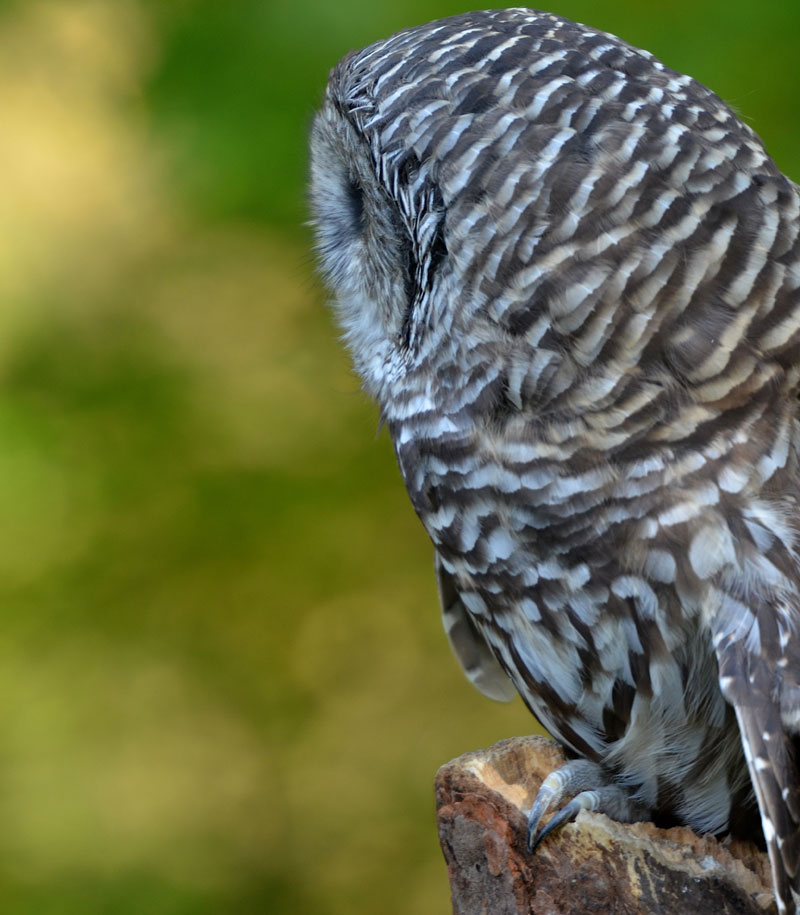

Priscilla, the Barred Owl...
Priscilla was admitted to RAPTOR, Inc. back in 2007. She was a victim of a car strike, sustaining a left wing fracture at the elbow. Most of the birds that flow through RAPTOR are treated, rehabbed, and released back into nature, but some can never heal from their injuries and stay on as permanent residents and working birds. RAPTOR, Inc. is a non-profit organization committed to the preservation of birds of prey. RAPTOR stand for the Regional Association for the Protection and Treatment of Raptors. Members of RAPTOR, Inc. rehabilitate and care for injured birds of prey until they can be released back into the wild. If you're a Cincinnati birder, you probably already know that Susan Williams of Susan Gets Native is the Education Program Director at RAPTOR, Inc. Click here to see all of her posts and inside scoops on the permanent residents and working birds at RAPTOR. Click here for RAPTOR, Inc.'s HackBack newsletter and to learn how to donate to the organization, volunteer, or sponsor a banded raptor.
Thanks to Rick for inviting Matty and me to the shoot--we had so much fun, and thanks to Mark and Cindy Alverson for showing us the birds. I LOVED every minute--even when Earl the Vulture yacked up his rat! I'll have lots more posts this week of the amazing birds at RAPTOR...
Monday, May 31, 2010
Prothonotary Warbler exhibiting courtship behavior and displaying his tail feathers...
It's no secret that I do a lot of birding on the Little Miami Bike Trail, and for good reason...every time I'm there I see something cool. I usually hop on the trail at the old Peters Cartridge Company (commonly called the Powder Factory) on Grandin Road in Kings Mills and walk toward Morrow, going as far as the Lebanon fork. This little patch is always productive. If you’re familiar with this stretch, you probably know the hillside stream not too far from the Powder Factory with the tiny “observation deck.” Over the years people have carted stones from the creek bed up the steep banks to create a rustic patio that lets you look down at the stream and follow its course up through the heavily wooded hillside. The water runs at a nice pace here and gathers in small pools along the way creating little watering holes perfect for sipping out of, especially if you’re a bird. I always check the watering holes to see what might be there. It's a great place to spot thrushes, and a Barred Owl is often hanging around too. I will see him well up the hillside sitting over the water, just watching. He’s usually so far up the hill you can only see him with the binocs, but if you know where to look, you’ll spot him frequently. Once, he sat in a tree about 10 feet from the patio. I stood and watched him, mesmerized, but this post is about a Prothonotary Warbler, so I had better get back on track! ...I had just walked back from the little patio, and as I stepped on the trail, a Prothonotary Warbler landed on the bridge railing about 15 feet from me. I was so surprised I froze! I watched him for a few seconds and slowly raised the camera to get his photograph. I didn't want to scare him off. This guy was so gorgeous and so close he unnerved me!

He soon flew down on the trail and started hopping around, spreading his tail feathers even more and leaning a little off balance. At first I thought he was hurt, but then I realized he was exhibiting courtship behavior and showing off his lovely tail for a female up in the tree. Every couple seconds he would look up to see if she was still watching him…


Eventually he flew up into the tree, and I walked on. If the couple was nesting close by I didn’t want to disturb them. Prothonotary Warblers are the only warblers in our area that nest in tree cavities, and they often nest over water, so this slow-moving stream would be a perfect place for a nest site. I read a long time ago that fledgling Prothonotary Warblers are born with the ability to swim. Since their nest cavities are often over water, it's not uncommon for them to fall out of the nest and into the water! The Smithsonian’s Migratory Bird Center’s site confirms this, as does the Cornell Lab of Ornithology’s Nestwatcher’s Resource Center.


A Prothonotary Warbler perched on the wooden railing of a bridge spanning a small stream. I was a bit shaky when I took this photo. He surprised me by flying in so close, which sort of sent me for a loop! You know that feeling...you're trying to move quickly and slowly at the same time while adrenalin floods your system and you forget to breathe... I didn't really pull this shot off, but you can see how he was fanning out his tail feathers to display for the female.
He soon flew down on the trail and started hopping around, spreading his tail feathers even more and leaning a little off balance. At first I thought he was hurt, but then I realized he was exhibiting courtship behavior and showing off his lovely tail for a female up in the tree. Every couple seconds he would look up to see if she was still watching him…

...this is the first time I've had a Prothonotary Warbler walking the trail with me!
He would hop a little and look up, then move forward and look up again. It took me a while to figure out he was looking up to make sure the female was paying attention to him.

...he continued to hop forward, fanning his tail.

...look at that cute little eye. He is soooo looking up to make sure his honey is watching him!
Eventually he flew up into the tree, and I walked on. If the couple was nesting close by I didn’t want to disturb them. Prothonotary Warblers are the only warblers in our area that nest in tree cavities, and they often nest over water, so this slow-moving stream would be a perfect place for a nest site. I read a long time ago that fledgling Prothonotary Warblers are born with the ability to swim. Since their nest cavities are often over water, it's not uncommon for them to fall out of the nest and into the water! The Smithsonian’s Migratory Bird Center’s site confirms this, as does the Cornell Lab of Ornithology’s Nestwatcher’s Resource Center.


Holy Cow...it's been over two weeks since I posted!!
What is up with that? I have so many photos and half-written posts in the pipe. I really need to get cracking and get these things up. I also haven't been able to get out and visit anyone's blog. Things have been so busy, but there is light at the end of the tunnel (I hope it's not the train!).

...I thought I'd sneak this one in. If you look a third of the way down on the right, you can see the silhouette of the Barred Owl sitting on a branch overhanging the stream. I was shooting through a dogwood in blossom, and he was just a spec with the naked eye. I've cropped the image a lot to show him. In person, the view was gorgeous. I've found him in this exact spot many times...
Saturday, September 12, 2009
Barred Owl in the Cataloochee Valley of the Great Smoky Mountains...and a bear in Asheville, NC!
My cousin, Steve, who lives with his family in beautiful, beautiful Asheville, North Carolina just sent me these shots of a Barred Owl. He, Kim and Zander were camping in the Cataloochee Valley of the Great Smoky Mountains National Park when they stumbled upon this unsuspecting slumbering owl. Looks like he groggily opened his eyes for the second shot. What a beauty!


A Barred Owl sleeping deep in the woods of the Great Smoky Mountains...

(For close-up photos of a Barred Owl, click here.)
Here is another photo Steve sent me. This one from his backyard....what do you think?

Isn't that cool? This guy weighs about 400 lbs according to the wildlife biologist who measured its tracks and studied several photos of it. The picture is about 4 years old, but the bear visits his neighborhood regularly. There are also smaller bears that come around. Coyotes visit as well as bobcats. Last year a few neighborhood cats went missing... Also last year they had a hen turkey and 16 chicks staying in their yard. The fowl seemed to like roosting on their compost pile. If I list out all the birds that visit his backyard, the post would go on forever. Needless to say, I'm jealous... Asheville, NC is a birder's wonderland.

Isn't that cool? This guy weighs about 400 lbs according to the wildlife biologist who measured its tracks and studied several photos of it. The picture is about 4 years old, but the bear visits his neighborhood regularly. There are also smaller bears that come around. Coyotes visit as well as bobcats. Last year a few neighborhood cats went missing... Also last year they had a hen turkey and 16 chicks staying in their yard. The fowl seemed to like roosting on their compost pile. If I list out all the birds that visit his backyard, the post would go on forever. Needless to say, I'm jealous... Asheville, NC is a birder's wonderland.
Subscribe to:
Posts (Atom)



 Posts
Posts


