Tuesday, September 22, 2015

Common Buttonbush along the Little Miami River...

A few weeks ago Matty and I went up to Spring Valley Wildlife Area along the Little Miami River with our sketchbooks. We spent the afternoon rambling about, sketching whatever we saw. When we came across a stand of Common Buttonbush (Cephalanthus occidentalis), we stopped and studied the tree and its blossoms, noting that the leaves occurred in whorls of three, and the "honey bell" was made of hundreds of tiny blossoms...

A Buttonbush inflorescence is a grouping of small flowers. The projecting needle-like styles create the starburst.
Common Buttonbush flower ball, also called a honey bell, dangles from a stem and looks a lot like a firework display, a starburst...or in a less romantic view, a pin cushion! 

Common Buttonbush is native to Ohio. It loves water and swampy areas, and true to form, we found a large colony hugging the edge of the lake and another in a low boggy area beside the lake, just steps from the Little Miami River. The flower balls were intensely fragrant, which is where it gets its nickname "honey bell" or "honey-ball," and butterflies were everywhere...

A female dark morph Eastern Tiger Swallowtail (Papilio glaucus) nectars on a Buttonbush flower-ball (inflorescence). The butterfly uses its proboscis to sip nectar from each tiny perfect flower and pollinates the florets in the process. 

Silver-spotted Skippers and Tiger Swallowtails were all over these flowers.
Two Silver-spotted Skippers (Epargyreus clarus) cling to the pin cushion for a sip of nectar as well. The long, projecting styles of each perfect flower in the inflorescence create the pin-like, starburst look.

The cranberry red stems of a Common Buttonbush shrub are almost as striking as its flowers. Its leaves have both a three-stemmed whorled arrangement (often near the flower) and an opposite arrangement elsewhere on the shrub.

Before the inflorescence bursts open, the tiny flowers (florets) are encased in tight mint-green buds (sepals). Here the flowers are just starting to open, but you can still see remnants of some of the buds and the light-green color.

After the flower petals have fallen away, little ball-shaped seed heads remain. Some will hold on through the autumn and winter. Each tiny flower in the inflorescence produces two seeds called nutlets. Often buttonbush trees grow at the edge of ponds, lakes, streams and rivers (or even in the water), so when the nutlets ripen and tumble out, they float and are dispersed by the currents. Wood Ducks, Mallards, teal, and other waterfowl like to eat the nutlets.  

For more information on the Common Buttonbush, including its historical use as a quinine substitute for malaria, look in "The Book of Swamp and Bog; Trees, Shrubs, and Wildflowers of Eastern Freshwater Wetlands," by John Eastman, pgs 34-37. For an online resource, click here for a link to The Hilton Pond Center's website, or here for the Ohio Department of Natural Resources Division of Forestry website.

What is an inflorescence?
When you look closely at a Buttonbush flower you'll notice it's a collection of hundreds of tiny flowers, called florets. Each one of the florets in the collection is a "perfect flower," which means it has a pistil (stigma, style and ovary) and stamens (anther and filament). The collection or grouping of florets is called an inflorescence. Common flowers with inflorescences are sunflowers and all the flowers in the daisy family. Click here for a past post called "Hummingbirds and sunflowers" that describes an inflorescence in more detail.


Tuesday, September 15, 2015

To attract Cedar Waxwings to your yard, let the pokeweed run wild...

The dark purple-blue berries of Common Pokeweed (Phytolacca americana) are irresistible to Cedar Waxwings. So much so that I don't even have to look out the window to know when they start to ripen. As soon as I hear the high-pitched, magical chittering of a flock of Cedar Waxwings in our backyard, I know the pokeberries are in season...

Pokeweed berries are nutritious for birds. Their dark color and beautiful light purple stems are attractive in the garden as well.
Common Pokeberries are ready for plucking and eating (by birds only; pokeweed berries are poisonous and can make humans sick). As soon as the berries are ripe, Cedar Waxwings descend and start feasting.  

These photos are from August 5 when most of the berries were not yet ripe. It was the beginning of their fruiting season, but it didn't stop the Cedar Waxwings from moving in. They knew exactly where every ripe berry was and wasted no time taking advantage of the nutritious summer treat. Now, the established plants are mostly picked over, but younger plants growing beside their elders are dripping with the dark, plump berries. In the wild, pokeweed plants look common, but in the suburbs, they look intensely exotic. Their cranberry red stems and racemes create an exciting backdrop to the dark blue fruit, and as autumn progresses, the colors only intensify. Our first stand of pokeweed started as a volunteer in 2008. At first I didn't know what it was, so I just let it grow, and did it ever grow. It grew tall and wide and arching, and soon it was dripping with chartreuse berries, but when they started to ripen, the fun really began. The first birds to eat the dark berries were robins, then came catbirds, and finally Cedar Waxwings. Over the years the catbirds still come, and the robins do too, but the Cedar Waxwings are the biggest consumer. I have a lot of pokeweed plants scattered around my yard, so I hear their chittery, magical sounds all summer.

A Cedar Waxwing looks for ripe berries. (There are two birds in this photo...can you see the second bird at the bottom near the right.) These two birds are part of a flock of 6 birds that regularly forage in our backyard. Earlier in the season, they feasted on mulberries from our 6 mulberry trees. 

A Cedar Waxwing swallows a pokeweed berry whole. You can see the bird's gular pouch distending to hold the berry (click here to learn more about gular pouches). 

If Thoreau liked pokeweed...
...it has to be good, right? I was reading "The Book of Field and Roadside; Open-country Weeds, Trees, and Wildflowers of Eastern North American," by John Eastman, and came across a reference to Thoreau where he wrote, "its stems are more beautiful than most flowers," which is true. You can't walk past the plant without taking a second look. I wanted to see what else Thoreau said about pokeweed, so I looked up the passage and found it in "The Writings of Henry Davide Thoreau, Volume 10," page 393. Click here for the online link to the free ebook. He goes on to describe them in detail as only Thoreau can, ending with "It is a royal plant. I could spend the evening of the year musing amid the poke stems."  

Pokeweed has a wide spreading habit. This is just one plant (and it's only half of it!). Pokeweed grows 4-10 feet tall, and its berries can remain viable for 40 years. 

Pretty to look at, but leave the berries for the birds (all parts of a pokeweed plant are toxic to humans). 

Pokeweed is a poisonous plant...
If you have children, pokeweed might not be a good plant for your yard. The roots are the most poisonous, followed by the leaves and stems, and then the berries. Children can be sickened by eating as few as 10 berries. Babies are especially vulnerable to the toxins and can die after eating only a few berries. The roots are deadly, and you should wear gloves if pulling the plant while it's alive (the juices can harm the skin). To learn more about pokeweed, click here for The Ohio State University's "Ohio Perennial and Biennial Weed Guide."

Mulberries attract Cedar Waxwings too...
In late May and Early June the mulberries in our yard start to ripen, and they are the first berries to welcome back the waxwings, but their season is short, and by July, they are gone, which makes pokeweed so perfect. It lures the Cedar Waxwings back in, and we get to listen to them all the way through the end of summer and early autumn.

A Cedar Waxwing sits in one of our mulberry trees. He's not looking for fruit in the tree. It's been gone for a long time. He's looking at the pokeweed bushes near the tree...

Thursday, September 3, 2015

Busy little caterpillar, eat, eat, eat...

As a prequel to the previous post of the monarch chrysalis and the butterfly's first flight, I thought it would be nice to look closely at a monarch larva. I was able to use my macro lens to get a closeup of a monarch caterpillar (5th instar) chomping its way through a milkweed leaf. It gives you a good idea of how fast a larva can devour a leaf, and just how much it eats (practically nonstop) to be able to grow so quickly and move through 5 instars...


When the larva is ready to molt, it becomes very still and latches itself to a leaf with silk it produces from a spinneret located on its lower lip. The head capsule is the first to molt, and the cuticle (outer skin) then splits down the back. Below you can see the caterpillar just after it escaped from its cuticle (the grey mass behind it). It has now moved into its fifth instar. You can tell which instar a monarch larva is in by the size and shape of its tentacles. To learn more about monarch larva and instars, click here for a pdf version of "A Field Guide to Monarch Caterpillars (Danaus plexippus)," by Karen Oberhauser and Krista Kuda, or here for the monarch life cycle on the University of Minnesota's website. 

Our monarch caterpillar has just molted into its 5th instar. You can see the thin, crumbled cuticle behind it. 

In the following video, you can see the very end of the caterpillar shedding its skin. The quality isn't great, because I took it with a cell phone instead of my camera, but you get the idea... 


Monarch caterpillar shedding its cuticle (outer layer of skin) from Kelly Riccetti on Vimeo.


Where is its head?
At first it's a little hard to tell the front end from the back end of a monarch caterpillar. Both ends have black fleshy tentacles that resemble antennae, but when you look a little closer, it's easy to tell the difference. First look at the tentacles. The front pair are much longer than the back pair. The front tentacles function as sense organs similar to antennae, but the back pair are thought to be defensive to confuse predators on which end is the head. Second, look at the legs. Three pairs of jointed "true legs" are in the front. Five pairs of "false legs" (prolegs) are attached to the abdomen all the way to its rear. 

The monarch caterpillar's larger tentacles are near its head. Three pairs of jointed true legs are on the thorax near the head as well. In the photo above, the head is on the right (you can't see the third set of true legs).

What's the difference between true legs and prolegs?
Caterpillars have three pairs of true legs attached to the thorax. These legs are segmented and often have a claw on the end. They help the caterpillar hold its food. If you look closely in the photo below, you can see the tiny claws at the tips of the true legs on the monarch caterpillar. True legs transform into the legs of the adult insect during metamorphosis. Caterpillars also have prolegs attached to the abdominal segments, but the number of pairs varies among species (monarch caterpillars always have five pairs). Prolegs are stumpy, cylindrical, and unsegmented. They also have microscopic hooks at their tips that work like suction cups to help the caterpillar cling to stems and leaves. The prolegs dissolve during metamorphosis.

In this close-up you can see why monarch tentacles are always described as "fleshy." They are not segmented like an adult insect's antennae, they are fleshy. You can also see a close-up of the three segmented true legs on the thorax.


Cuteness! A monarch caterpillar was underneath the leaf munching away, then another crawled over the top and started to eat as well. When the two "met in the middle," they touched heads, looking a little smoochy-smoochy. The caterpillar underneath shook its head and moved to the other side of the midrib of the leaf. No time for that...must eat more milkweed leaves!

Thursday, August 27, 2015

Monarch butterfly—from chrysalis to flight...

In a post earlier this summer, I mentioned a monarch butterfly had found our little milkweed stand. I had hoped she would return and lay an egg...and she did! She (and maybe a few of her sisters) laid many eggs. We've counted 11 caterpillars so far in our backyard monarch nursery, and the first went from chrysalis to flight Tuesday afternoon...

You can see the butterfly curled inside the clear case. Just days earlier, the pupa was a light green. Metamorphosis occurs in 9-14 days.
When the caterpillar first forms a chrysalis, it is a light jade green. After about 9 days, it starts to darken until finally it is crystal clear and you can see the butterfly locked inside. When you see the Monarch's orange and black wings clearly through the pupal case, get ready to welcome a butterfly into the world. (Our butterfly emerged about 10 minutes after I took this photo.)

Dangling from the spent chrysalis, the newly born butterfly dangles to let the wings dry and expand.
A newly emerged monarch butterfly dangles from its pupal case (10:41 a.m.). Her wings are wrinkled and wet. She must expand the wings by pushing hemolymph (bug blood) into the wing veins.

A close-up of the pupal case.
Butterflies secrete a liquid to help soften the chrysalis (pupal case) so they can emerge (eclose). You can still see droplets of the liquid inside the chrysalis. 

In this photo you can see the chrysalis on the left side and the butterfly on the right.
As the wings straighten out and harden, the butterfly starts to climb higher and away from the spent chrysalis (12:21 p.m.). 

a straight-on photo of the butterfly. Her black and white polka dots stand out.
Our new monarch butterfly hangs from a milkweed leaf clearly chewed and eaten away by a monarch caterpillar (maybe by her two weeks earlier).

A Monarch butterfly has orange wings with heavy black lines like stained glass...all accented with black and white polka dots!
The wings continue to straighten and harden. It's been a little over two hours since the butterfly emerged (12:50 p.m.). 

 Her wings are considerably harder and straighter...she's gorgeous, but she still hangs tight, not moving. The black and white polka dots on her head, thorax, and wing tips are just as striking as the orange color in her wings. 

The baby monarch's wings are now strong enough to open, and we get to see the deep orange color.
Like a toddler beginning to walk, our newly emerged monarch flaps her wings for the first time (1:03 p.m.). It's been almost 2.5 hours since she broke out of the pupal case.

Black and white polka dots act as disruptive camouflage for the butterfly.
Finally, almost another hour later, at 1:58, she is ready to try her wings. I switched over to video to capture her flight. 
I knew it would be soon...


Monarch Butterfly's First Flight from Kelly Riccetti on Vimeo.

What a crazy ride...
I had read it usually takes monarch butterflies about an hour to go from emergence to flight, but our little girl took almost 3.5 hours. She dawdled, and grew stronger, and dawdled some more. The longer wait gave me time to really think about the process of metamorphosis, and I'm glad for it. The more I thought about what was happening, the more amazed I was. I had been reading about the process of metamorphosis since I was a kid, but I had never witnessed every stage...from egg, to all the larval instars, to the chrysalis, to emergence and flight. It's an outrages process...and immensely cool to witness.

Monarch development at a glance...
Here is a quick timeline to get a feel for how long it takes to go from egg to butterfly. Monarchs undergo complete metamorphosis and have four stages of life—egg, larva (the caterpillar stage), pupa (the chrysalis stage), and adult.

Egg (3-6 days) 
Female Monarchs lay a single egg on a milkweed leaf (the only plant monarch caterpillars can eat). The eggs hatch in 3-6 days.

Caterpillar (9-15 total days in the larval stage; 5 instars, each lasting 2-3 days) 
When the egg hatches, the caterpillar is so small it's hard to see, but it grows very fast. Soon it can no longer fit in its skin, so it sheds its skin and continues to grow. Each time a caterpillar sheds is called an instar. Monarch caterpillars go through 5 instars before they are full grown.

Chrysalis (9-14 days in the pupal stage)
When the caterpillar is full grown, it finds a safe place to pupate, often roaming up to 20-30 feet away. It creates a tiny silk mat on the underside of the leaf and then attaches itself to the mat with its cremaster (the hooklike tip of the pupa). It then sheds its skin for the last time. Under the skin is a light green casing called a chrysalis. At first it is soft, but within an hour it hardens to a protective shell. Now is when the magic begins...one of the transformations going on within the casing is the change of mouthparts from chewing (caterpillars chew milkweed leaves) to drinking (butterflies sip nectar through their straw-like tongue called a proboscis). Additionally, legs change, eyes change, and wings sprout. For 9-14 days the caterpillar totally transforms into a butterfly ready to take to the sky.

Butterfly (Adult: 1-4 hours after emerging can fly, 4-7 days later can mate, dies 2-6 weeks later)
When a butterfly cracks open the chrysalis, it emerges (ecloses) with wet, crumpled, and useless wings. It takes 1-4 hours for the wings to straighten, harden and dry. It is at its most vulnerable now because it is helpless and can't fly. Just 4-7 days after taking flight, butterflies are ready to mate...and start the process all over. Adult butterflies born in the summer don't migrate and live for 2-6 weeks. Those that are born at the end of summer do not mate and lay eggs. They can't survive here in the winter, so they put their energy into migrating (to Mexico) until spring when they return north to mate and lay eggs. "Winter" monarchs live 7-9 months.

For details on the Monarch's lifecycle, click here for a page from the Monarch Butterfly Fund, and here for the National Wildlife Federation's page.

Monarch camouflage—disruptive coloration and warning coloration (with Müllerian mimicry)
There are many types of camouflage in the animal kingdom, and the monarch butterfly exhibits two. You would think the black and white polka dots on a monarch's head, thorax and wing tips would draw attention to it, but it's just the opposite. The black and white dots create a disruptive coloration that acts as camouflage. The disruptive coloration breaks up the outline of the butterfly's head, making it more difficult to see.

In an opposite fashion, the bright orange attention-drawing color in the monarch's wings is a warning coloration meant to convince birds and other predators to shy away. Monarchs are toxic from their larval diet of milkweed leaves, and birds quickly learn to ignore the horrible-tasting butterflies, making the incredibly noticeable color its camouflage. Monarchs also exhibit Müllerian mimicry, where two equally toxic species mimic each other to the benefit of each, enhancing their "scare appeal!" The viceroy butterfly looks similar to a monarch but is also unpalatable. Previously, the viceroy was thought to exhibit Batesian mimicry (where butterflies not as toxic mimic the monarch for protection), but in 1991 it was proven that viceroys were just as unpalatable as monarchs, and they mimic each other for mutual protection.  Click here for the article, "The viceroy butterfly is not a batesian mimic," by David B. Ritland and Lincoln P. Brower in the journal Nature, for details, or click here for an article titled, "Mutual Mimicry: Viceroy and Monarch," by Kara Rogers on the Encyclopedia Britannica Blog.

Prequel...the caterpillar!
If you want to see a monarch caterpillar, click here for the prequel to this post.

Monday, August 24, 2015

Spotted Jewelweed sparkles along the Little Miami River...

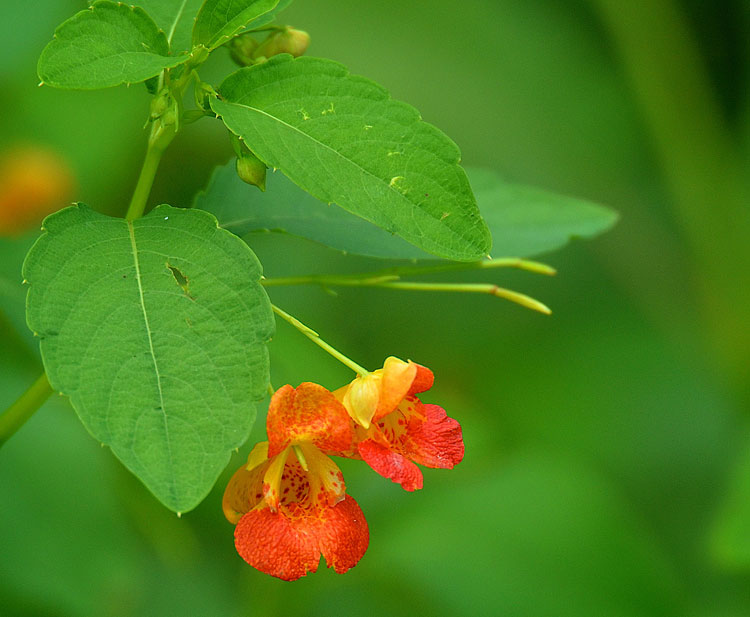
Bright splatters of orange along the riverbank in August can mean only one thing, Spotted Jewelweed (Impatiens capensis) is in bloom! Matty and I saw these orange gems last weekend along the Little Miami River at Spring Valley Wildlife Area. The temps were warm, the humidity was high, and the cicadas were singing...all indicative of late summer and the slow march to autumn...

Coevolution of jewelweed and hummingbirds is much studied. The shape of the nectar spur is perfect for its principle pollinator, hummingbirds.
A Spotted Jewelweed flower dangles from a translucent green stem. This beautiful flower is a powerhouse of fuel for the Ruby-throated Hummingbird during fall migration. 

A hummingbird's horn of plenty...
Spotted Jewelweed's conical horn-shaped flower with its tubular nectar spur was made for hummingbirds, literally. The flower coevolved with hummingbirds and is the main nectar source for the tiny bird on its return flight south in late summer and early fall (jewelweed blooms well into October). In return, the hummingbird is the flower's main pollinator. The downward angle of the nectar spur forces the hummingbird to go deeper into the flower to reach the nectar, which means more pollen ends up on the hummingbird's head, ensuring pollination and making the hummingbird a very efficient pollinator.  To learn more about nectar spurs and pollinators, click here for the article, "The relationship between nectar spur curvature in jewelweed (Impatiens capensis) and pollen removal by hummingbird pollinators," by Steven Travers, Ethan Temeles, and Irvin Pan.

When you look at the flower, it has a cone shape that resembles a horn. The nectar spur is located at the base,  which is a perfect location for a hummingbird.
When you look at Spotted Jewelweed in profile, you can see how its horn-of-plenty shape and the small tubular spur at the base of the flower that holds nectar is perfect for a hummingbird.

Disperses seeds like a pro...
Jewelweed's common name, Touch-me-not, comes from its unusual method of seed dispersal. When the seed pods ripen, the slightest touch (even that of a strong breeze) triggers a pop that ejects the seeds up to four feet away. Unlike most wildflowers, Jewelweed is an annual, not a perennial, which means its only way to reproduce is through seed. Efficient seed dispersal is critical to its survival, so it's no surprise it has developed such a cool method of ensuring its seeds get distributed. In addition to jewelweed's showy horn-shaped flower, another type of flower called a cleistogamous flower contributes to seed production. This flower is inconspicuous, small and green, and it never opens. It is self pollinated, and when it ripens, the seeds are not thrown as far. Botanists assume this ensures some seeds stick close to the parent plant where they will thrive in the same habitat. The seeds from the pollinated flowers come from genes from two parents and are more likely to be able to survive in conditions that might be slightly different, so they are tossed far and wide. Additionally, it's scientific name of "Inpatiens" derives from this "impatient" explosion of seeds. Source: "The Book of Swamp and Bog; Trees, Shrubs, and Wildflowers of Eastern Freshwater Wetlands," by John Eastman, pgs 91-95. (p.s. This book is part of a series of three. The other two are "Forest and Thicket" and "Field and Roadside." I love them because they go into detail with lots of interesting tid bits!)  

The deep oranges and reds of Spotted Jewelweed are a preview of the warm colors of autumn. It's a perfect transition flower from summer to fall.

The conical shape of a jewelweed flower is perfect for a hat for a fairy or gnome. When whimsy and imagination take over...
...if you want to wax whimsical, this little flower could totally be a hat for a little flower fairy or gnome. Too cute!

Jewelweed needs a lot of moisture to grow well. The dense colonies often form along waterways and muddy and wet ditches.
Jewelweed reseeds itself and grows in large colonies. It forms a dense canopy and can crowd out noxious weeds (much to the delight of migrating hummingbirds in late August, September, and early October).

Sparkling silver leaves...
I used to think jewelweed was named for its jewel-toned orange and yellow colors, but it's not. Several years ago, I photographed the yellow-colored jewelweed (Impatiens pallida), and after researching it, I learned the moniker referred to the leaves. When water droplets form on the leaves, they shine like tiny, sparkling jewels, and when the leaves are placed under water, the underside shines like silver. Click here to see photos of Yellow Jewelweed (Pale Touch-me-not). The post also covers its use as an antidote for stinging nettle burns, poison ivy rashes, and mosquito bites!


Saturday, August 15, 2015

Indigo Buntings, Giant Ragweed, and hints of fall...

If you're in the mood for Indigo Buntings, head to Armleder Park and look...anywhere! My cousin, Curg, and I walked the Little Miami River and the trails at Armleder on Tuesday, and we saw more Indigo Buntings in one place than I ever have. They were everywhere...singing, flying, singing, hiding, singing, nabbing insects, and singing some more⎯and their plant of choice for perching on was Giant Ragweed...

A beautiful male Indigo Bunting sang cheerily from his perch on a stalk of Giant Ragweed in the big meadow near the Little Miami river at Otto Armleder Memorial Park. 

While most birds have quieted for the season, male Indigo Buntings continue to sing for all they are worth. Their constant singing makes them easy to spot. We found them all along the connector trail, the fields at the beginning of that trail, the trails that go through the meadow, and the forest openings around the Little Miami River. The only place we didn't see or hear them was in the small stretches of deeper woods, which makes sense because Indigo Buntings are birds of woodland edges, scrubby fields, and riparian corridors. They are one of the few neotropical migrants that have benefited from the clearing of forests for farmland, and they continue to expand their range.

Common to some, exotic to others...
The Indigo Bunting is a strange case when it comes to "being appreciated." Because Indigo Buntings are common birds in their favored habitats, I often hear birders dismiss them with, "Oh, it's just another Indigo Bunting," but I've heard new birders or people who live in cities or suburbs not near the bird's habitat, exclaim, "Oh, wow, what is that blue bird? It's so blue!" or "Cool, it's an Indigo Bunting!" Same bird, polar opposite reactions. I love Indigo Buntings whenever I see them. Their song is happy...and when the sun strikes them (the blue color is structural and only shows in the sunlight; it's not a blue pigment), they are exotic looking, and I definitely appreciate them. To me they always carry a slight zing of surprise, so it was fun seeing them again and again and again at Armleder.

Giant Ragweed towers over the fields and can be found all over Armleder Park. 
It is a native annual that can grow up to 15 feet tall. 

About Giant Ragweed (Ambrosia trifida)...
...it's a native plant, but it grows like a noxious weed in crop fields. Quail and other critters might like it, but farmers don't, except for one "Contrary Farmer" who wonders about practical uses for it⎯click here for his article, "The Irony of Giant Ragweed." In the article, Gene Logsdon outlines the horrors of Giant Ragweed in the fields, but he also talks about how much his sheep love it and how quail and pheasants thrive on a diet of it. Native Americans nurtured it 2000 years ago, and its seeds are 47% crude protein, which is much higher than any cultivated grain. To top it off, it's easily digestible. He ends by wondering if "...we are looking at the ultimate irony of over-civilized humankind. We are trying to kill a plant, an ambrosia, that is actually beneficial."

For other information about Giant Ragweed, click here for a fact sheet from the University of Tennessee, and here for the article "Giant Ragweed - Revenge of a Native," by Bob Hartzler from Iowa State University. Allergy sufferers, run. Just like Common Ragweed, Ambrosia trifida is a major contributor to seasonal allergies and late summer early autumn hay fever.

Other beauteous things found along the way...
We saw Red-winged Blackbirds starting to group in large flocks for their big trip south, and even though it was warm, hints of Autumn were apparent. Here and there the deep red of spent Poison Ivy leaves popped among the green, and the purple of Tall Ironweed (Veronia altissima) was splashed across the fields, hurrying along the shift of nature's color palette to the rich hues of fall...

Tall Ironweed (Veronia altissima) is starting to bloom in the meadow at Armleder. Like Giant Ragweed, this plant can get very tall, but it tops out at seven feet. 

A female Red-winged Blackbird eats a grasshopper she nabbed off a Tall Ironweed plant, which is just about to burst open in deep purple flowers.

Wild grapes ripe for the plucking. When the catbirds I heard singing by the river find these juicy treats, they won't last long!

...even though I'm trying to ignore the signs of fall, they keep coming. Ripening wild grapes signal the beginning of autumn and help fuel fall migration in late summer and fall for many migratory songbirds.

Click here for a link to a guide The Nature Conservancy put together titled "Managing Habitats for Migrating Land Birds in the Western Lake Erie Basin--a Guide to Landscaping and Land Management." Even though it was written for residents of the Western Lake Erie Basin, the information transfers to our area as well. Migrating birds need food sources at stopover sites during migration, and the plants we choose for our yards, such as wild grapes and other fall-ripening berries, can help them on their journey south.

...a few of the birds who like to eat wild grapes are Gray Catbirds, Eastern Bluebirds, Great Crested Flycatcher, Northern Mocking birds, American Robins, Brown Thrashers, Cedar Waxwings, Baltimore Orioles, Tufted Titmice, Wood Ducks, woodpeckers...and the list goes on and on. 

...cuteness on the ground. This tiny, tiny baby Fowler's Toad decided to cross the path as we walked by. With fall approaching, he's probably considered more toddler than baby, but he was baby cute...probably about the size of a quarter.

The shift from late summer to fall happens quickly, and soon all the work accomplished through the summer by trees, flowers, and other plants will be put to rest, while birds, forest animals, and humans harvest their bounty (it's probably a good time to hug and thank a tree!).

Thursday, August 6, 2015

Summer is...hummingbirds!

As the squeaky-squeak chatter of hummingbird-speak rattled back and forth across the deck, a light evening breeze ruffled the pages of the book I was reading. It was a freshening breeze, but fleeting, and it reminded me to put the book down and listen to the season before it was gone…

When you can hear hummingbirds squeaking through open windows, you know it's summertime!
A young male Ruby-throated Hummingbird preens in the plum tree beside our deck. Moments before, he had been squeaking and squawking like the warrior he is, having successfully chased two other hummers away from his feeder. 

Hummingbirds fight viciously when another tries to move in on their territory. For being such cute little birds, they are fierce fighters.
King of the North Feeder and all its environs...

The sounds of hummers fighting and squabbling over nectar is synonymous with summer around our house.
Bokeh 
Several people have emailed me asking how I captured the cool background. I had nothing to do with it. Mama Nature and timing took care of it. I photographed the bird around 6:00 p.m. on the north side of the deck. The hummer was sitting in a plum tree with beautiful maroon leaves. Behind the plum was a hornbeam tree lit by the evening sun. Its bright green sunlit leaves peaking through the dark maroon plum leaves created the splashes of color. I used a shallow depth of field to create the blurred background (bokeh), but truly Mamma Nature took care of the rest. Click here and here for a quick explanation of bokeh.  If you look at the two photos following, you can see the background has lost some of its punch. The shift of the sun killed the brightly lit green background leaves...

Juveniles and female hummingbirds look similar, but since this bird has pronounced markings on his throat, 
I think he is a male. Females are usually more white.

...little emerald pinecone feathers glitter in the sun.

With razor-sharp, stops, starts and spins, hummingbirds' aerial combat feats are amazing...and mesmerizing. It's hard to turn away from their supercharged swoops of acceleration and agility. These tiny birds have it going on, and their sounds and displays make me summertime happy, but they won't stick around for long. Adult males are the first leave. They head south about a month earlier than the females and juveniles. It's already August 6, and adult males often start their journey home by mid-August. I don't want to think about summer ending...and these little birds going with it, so I'll ignore the shortening days and enjoy the heat and hummer-squabbles as long as I can.

A slow-motion hummingbird video...
Rick was standing next to our trumpet honeysuckle plant when a hummingbird flew up and started sipping nectar from the long, tubular flowers. He had his cell phone on him, so he captured a little video. He used the slow-motion option, and it actually shows the figure-eight motion of the hummingbird's wings in flight (I added a little music for fun).


Ruby-throated Hummingbird in Slow Motion from Kelly Riccetti on Vimeo.

 
Ruby-throated Hummingbird in Slow Motion -- part 2 from Kelly Riccetti on Vimeo.