"Storm," the Barn Owl, is a teaching owl at
RAPTOR, Inc. in Cincinnati, Ohio. RAPTOR is a non-profit organization committed to the preservation of birds of prey. RAPTOR members rehabilitate injured birds of prey until they can be released back into the wild. Unfortunately, some have permanent damage and can't hunt or survive on their own, so they stay on at RAPTOR as educational birds. Last autumn I photographed many of their resident birds, and Storm was one of them. Storm was admitted to RAPTOR on June 26, 2007 as a nestling with a severe left wing soft tissue wound. The owl's left wing had been caught in the seam of a barn and was not able to be saved. Since then, Storm has become one of the most photographed and beloved of their educational birds (click
here for all past RAPTOR, Inc. posts).
Whenever I post photos of captive raptors, I always make sure to let artists know they can use the photos as references for their paintings, so I was especially happy when I heard from the very talented and interesting Virginia painter
Mary Chiaramonte. Mary put our beautiful Storm in one of her paintings and sent me a photo of it that I could post. If you look at the shed, Storm is perched on the right side of the roof...
 |
"Trespass" by Mary Chiaramonte
(Storm the Barn Owl is perched on the right side of the roof...looking very Stormy! I love the night-feel in this painting.) |
Mary's paintings are multi-faceted and very interesting. I can't stop looking at them! They are made up of layer upon layer of emotion. You'll have to take your time and study them. Click
here to see more of her paintings. Thank you, Mary for sending me the photo! If you are interested in keeping up with Mary's work, you can "friend " her on Facebook because she posts new paintings there:
http://www.facebook.com/mary.chiaramonte.9
Since Storm has been made famous in Mary's painting, I thought I would include a few more photos of our gorgeous star. These are all great reference photos for artists and painters focusing on cryptic feather patterns, wing shape, and close-ups of those amazing talons and feet...
 |
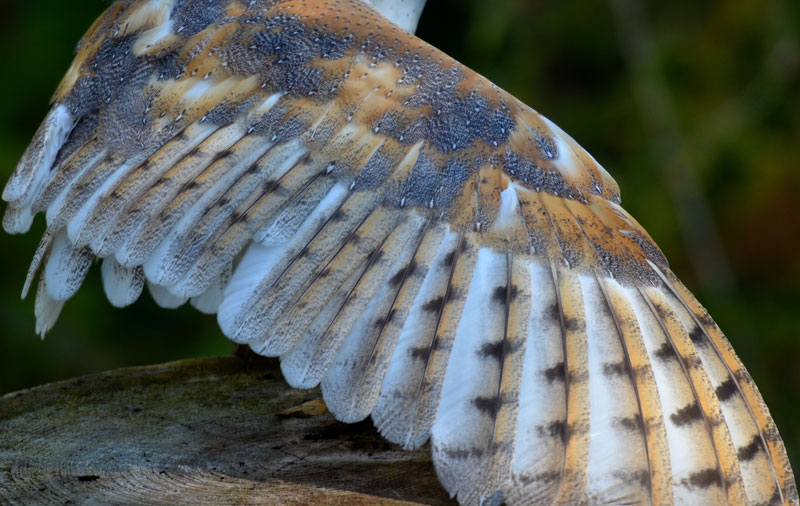
| Barn Owl feathers have beautiful cryptic colors and patterns to help camouflage it. |
 |
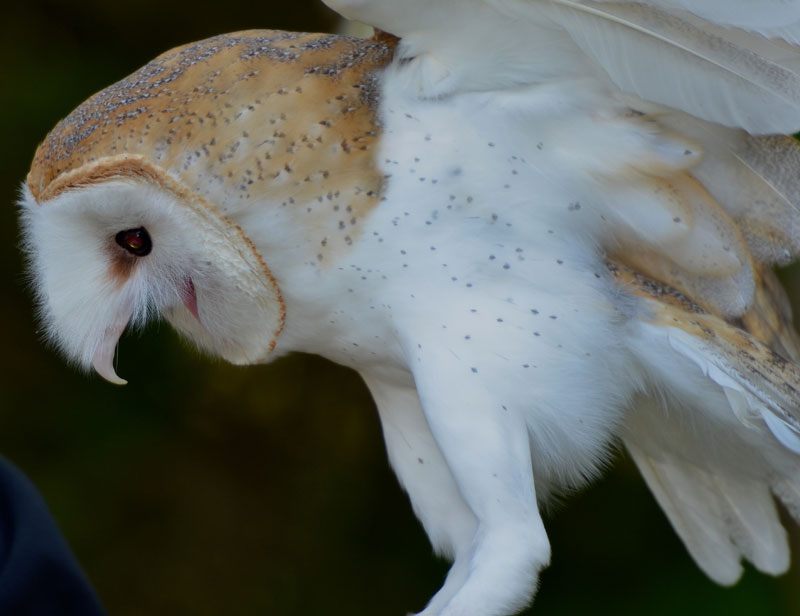
| ...a profile shot of Storm the Barn Owl with a bit of "eyeshine" triggered by the morning sunlight reflecting off the tapetum lucidum, a reflective layer of cells behind the retina that helps owls and other nocturnal animals see at night (click here for more about eyeshine and the tapetum lucidum). |
 |
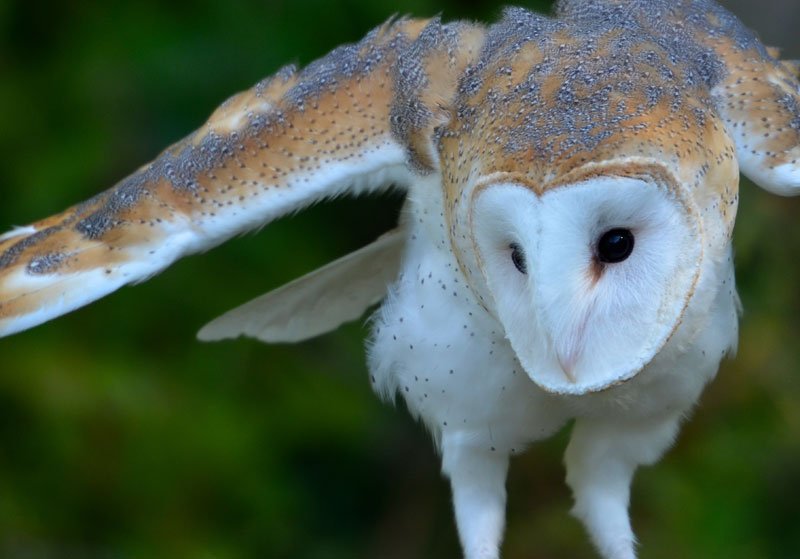
| Storm in the classic Count Dracula pose... |
 |
| The silent flight of nocturnal owls has intrigued humans forever. It's achieved because of a unique adaptation to the trailing feathers on the back end of the wing. The leading edge (primary feathers) are serrated, which helps with stability, but the trailing feathers are fringed and tattered and account for the silence by breaking up the sound waves generated as air flows over the top of the wings and forms downstream wakes (source: National Geographic, "Owls' Silent Flight May Inspire Quiet Aircraft Tech," by John Roach. Click here for the complete article). |
 |
| These large, forward facing eyes allow for good stereoscopic vision, which helps owls judge distances. Owls have the most forward facing eyes of all birds...and the flat face allows the eyes to be spaced as widely apart as possible to increase the stereoscopic effect. It's easy to see where the nickname, "Old Flatface" came from. For more on owl eyesight, click here. |
 |
| The strong, long and sharp talons on owls' and other raptors' feet can do a lot of damage and set them apart from other birds. Birds of prey have a locking mechanism that keeps the toes locked around their prey without having to use muscles to remain contracted. Click here for more specifics on owls' talons. |








 Posts
Posts


